Godot Community Poll 2025: 9,661 Devs vs Unity
9,661 developers answered the official
Godot Community Poll 2025
. The closest comparable Unity data is a community-run
Unity Community Survey
with ~48 respondents. Unity Technologies has not run a public community survey since 2022.
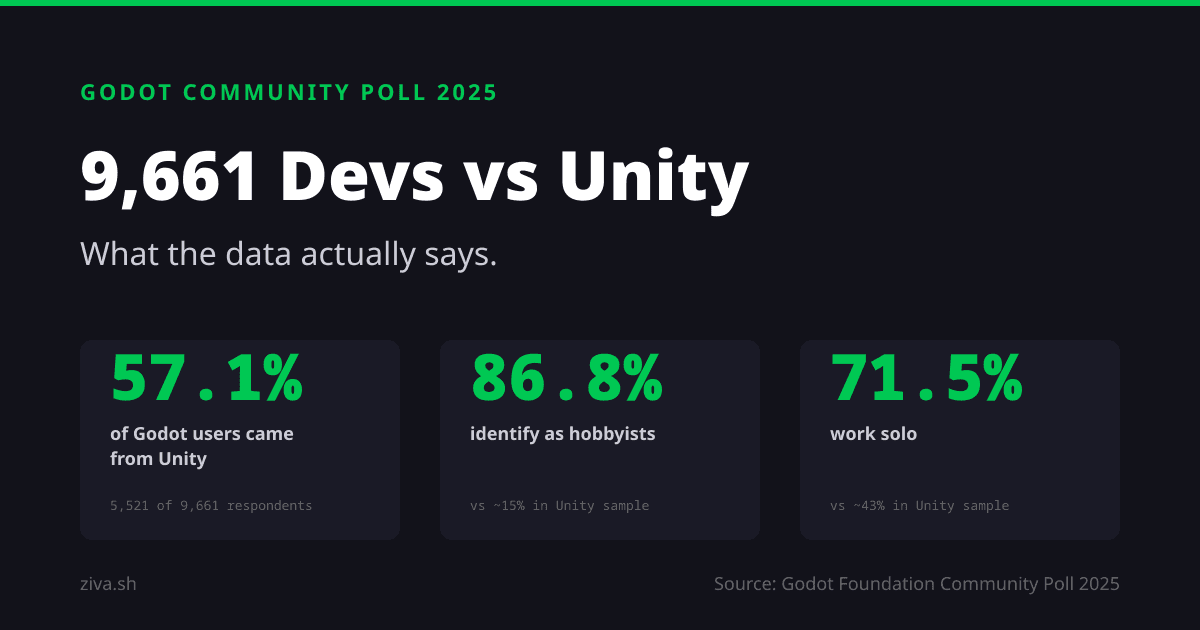
57.1% of Godot users came from Unity (5,521 of 9,661). Unreal is a distant second at 23.8%, GameMaker third at 19.4%.
Godot is a hobbyist + solo engine. 86.8% identify as hobbyists, 71.5% work alone. The Unity community sample skews the opposite way: ~78% are paid (employed or freelance), and 58% work in a team.
The 2D / 3D split is the real divide. 45.9% of Godot devs do 2D regularly; 79% of Unity devs do 3D regularly. Aseprite usage tells the same story: 46.4% Godot, ~6% Unity.
The official Godot Community Poll 2025 drew 9,661 respondents, and 5,521 of them (57.1%) used Unity before switching to Godot. That single line item explains most of Godot’s growth since the 2023 Unity runtime fee fiasco . We pulled the full poll, compared every overlapping question to the community-run Unity Community Survey (~48 responses), and the picture is sharper than either engine’s marketing suggests.
One engine runs a real poll. The other doesn’t.
The 200× gap isn’t really a fair comparison and that’s the point. The Godot Foundation runs its Community Poll annually , tabulates results publicly, and uses them to set roadmap priorities. Unity Technologies retired its public community-facing developer survey after 2022 and shifted to the Unity Gaming Report , a marketing artifact derived from internal telemetry rather than a self-report instrument. So when someone wants apples-to-apples Unity data in 2026, they end up at a private Notion page with three dozen entries. Take the Unity numbers below as directional, not statistical.
57% came from Unity. 20% came from Minecraft.
| Engine / tool used before Godot | Respondents | % of 9,661 |
|---|---|---|
| Unity | 5,521 | 57.1% |
| Other third-party engine / library | 2,543 | 26.3% |
| Unreal Engine | 2,298 | 23.8% |
| Minecraft (redstone, server, modding) | 1,981 | 20.5% |
| Game Maker | 1,877 | 19.4% |
| Own engine / technology | 1,587 | 16.4% |
| Did not develop games before | 1,464 | 15.2% |
| RPG Maker | 1,265 | 13.1% |
| Phaser / Pixi.js / other HTML5 | 721 | 7.5% |
| Cocos / LibGDX / SDL | 697 | 7.2% |
| Flash / Haxe | 643 | 6.7% |
| Roblox | 592 | 6.1% |
| Construct | 458 | 4.7% |
| Unreal Editor for Fortnite | 82 | 0.8% |
Unity isn’t the only source, but it’s the largest by a wide margin. The Minecraft entry is the surprise: 1,981 respondents (20.5%) came in through redstone, modding, or running a server, which is a hidden funnel that engines rarely talk about. Notable named migrations include Slay the Spire 2 moving from Unity to Godot, Brotato’s Blobfish saying the same in interviews , and Cassette Beasts shipping on Godot 3 in 2023. That migration story is the single biggest reason Godot adoption stats keep climbing.
Godot is the hobbyist engine. Unity is the studio engine.
| Capacity | Godot (n=9,661) | Unity (n=~48) |
|---|---|---|
| Hobbyist | 86.8% (8,382) | ~15% (7) |
| Self-employed / freelance | 27.7% (2,678) | ~44% (21) |
| Employed at a studio or company | 4.7% (452) | ~38% (18) |
| Student | (not asked) | ~2% (1) |
These columns sum to more than 100% because respondents could pick multiple (a freelancer also doing studio work, for example). The shape still inverts cleanly: Godot’s response pool is 87% hobbyists, Unity’s is 82% paid work. That maps onto the engines’ published licensing models. Godot is MIT-licensed and free forever; Unity charges $2,310/yr per seat once a project crosses $200K revenue (per Unity’s 2026 pricing ). When the price of the tool is your decision criterion, you’re a hobbyist or a small shop, not a studio with a procurement budget.
71.5% of Godot devs work alone.
| Team size | Godot | Unity (small sample) |
|---|---|---|
| Solo | 71.5% (6,904) | ~43% (20) |
| 2 – 5 people | 25.3% (2,440) | ~32% (15) |
| 6 – 15 people | 2.5% (241) | ~13% (6) |
| 15+ people | 0.8% (76) | ~13% (6) |
This is the same story from a different angle. Three out of four Godot respondents have nobody else on the project, which explains why a solo-friendly AI workflow lands harder in the Godot community than the Unity one, and why GDScript versus C# is a real argument in Godot land (77.9% GDScript, 16.4% C# in the same poll) while it’d be a non-question in Unity-land where studios standardize on C# for tooling.
Godot leans 2D. Unity leans 3D. The gap is huge.
| How often | Godot 2D | Godot 3D | Unity 2D | Unity 3D |
|---|---|---|---|---|
| Regularly | 45.9% | 36.9% | 19% | 79% |
| Occasionally | 33.4% | 30.7% | 15% | 15% |
| Rarely / not at all | 20.7% | 32.4% | 65% | 4% |
Aseprite usage is the tell. 46.4% of Godot respondents (4,269 people) use Aseprite, the dominant pixel-art editor. In the Unity sample, three of 48 do. That single data point is more useful than any marketing chart: Godot ships a 2D renderer that’s first-class, not a 3D engine bolted onto a 2D mode, and the pixel-art crowd has noticed. If you’re building a 2D game, the best 2D engines comparison puts Godot at the top for exactly this reason.
Linux and Web are Godot’s quiet wins.
| Export target | Godot % | Unity % (small sample) | Gap |
|---|---|---|---|
| Windows | 95.8% | ~81% | +15 pp |
| Linux | 68.4% | ~31% | +37 pp |
| HTML5 (Web) | 42.6% | ~23% | +20 pp |
| Android | 34.4% | ~46% | -12 pp |
| macOS | 35.5% | ~29% | +6 pp |
| iOS | 14.6% | ~33% | -19 pp |
| VR / XR / AR | 7% | ~19% | -12 pp |
| Consoles | 17% | ~21% | -4 pp |
Godot wins Linux by 37 points and Web by 20. Unity wins iOS and VR/XR by similar margins. That’s not random. Godot ships a first-class Linux build and the Godot Web export is well-trodden, while Unity has years of accumulated VR/XR tooling and Apple’s notary/code-signing chain that Godot is still building out. Console support is roughly comparable for the wrong reason: both require third-party porting services for nearly everyone.
Discord owns Godot. Reddit owns Unity.
| Community space | % Godot devs active there | % Unity devs active there |
|---|---|---|
| Discord | 52.2% | ~27% |
| 48.1% | ~83% | |
| YouTube | 32.3% | ~31% |
| Following content creators | 31.0% | ~19% |
| Forums | 21.1% | ~35% |
| GitHub / issue tracker | 19.0% | ~15% |
| Twitter / X | 12.3% | ~17% |
Godot’s center of gravity is the official Discord and a long tail of community-run servers like the Godot Cafe. Unity’s is r/Unity3D, where the post-runtime-fee threads still drive most of the engagement. If you’re shipping a tutorial or a plugin, that decides where you post first.
Three takeaways for engine choice.
If you’re a solo dev or small team building 2D: Godot is statistically your tribe. 71.5% of respondents are solo, 45.9% do 2D regularly, the pixel-art tool overlap is enormous. The AI tooling for Godot ecosystem has grown specifically because solo devs need a force multiplier and the engine is text-friendly enough that LLMs can work with it. Ziva is one of those tools, but GDScript’s text-first nature is the underlying reason the category exists.
If you’re shipping VR/XR or mobile-first: Unity still wins on tooling and platform support, and the data shows where the working Unity devs are (19% VR/XR vs 7% Godot, 33% iOS vs 14.6% Godot). Godot 4.6 is closing the VR gap with OpenXR 1.1, but ecosystem maturity is years away.
If you’re a studio choosing your next engine: The Godot poll’s 4.7% studio-employee share is the honest number to plan around. The talent pool is real but small. The flip side is that hiring a Godot dev means hiring someone who almost certainly came from Unity or Unreal (80%+ combined) and made a deliberate choice, which is a different signal than a Unity dev who never had to choose.
The Godot Foundation publishes the full poll dataset as CSV , so every chart above is reproducible. Whether the next Unity vs Godot decision deserves a real Unity counterpart, or whether the community survey on Notion is what we get, is up to Unity Technologies.