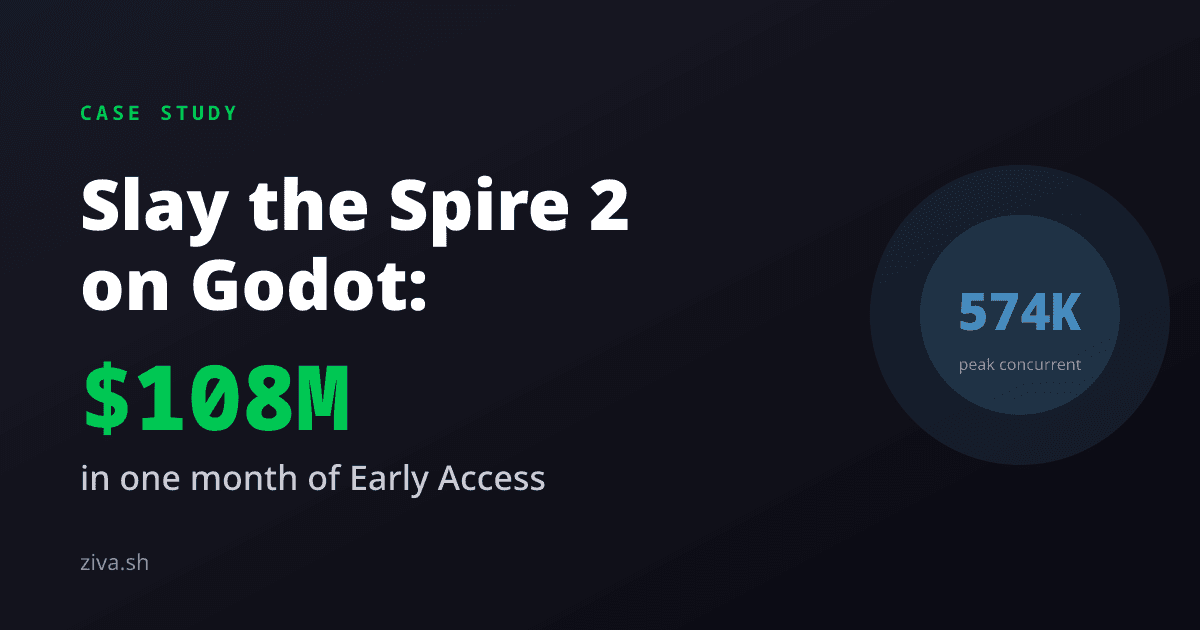
Slay the Spire 2 on Godot: A $108M Vindication
Mega Crit threw out two years of Unity work to rebuild Slay the Spire 2 on Godot.
The sequel launched March 5, 2026 and sold 3 million copies in its first week .
It peaked at over 573,000 concurrent Steam players during launch week, tripling the original’s record and entering Steam’s top 20 all-time concurrent peaks .
Estimated March revenue: $108 million and 5.3 million copies per Alinea Analytics , more than the Steam lifetime revenue of Hades II and Hollow Knight: Silksong combined , from a game still in Early Access.
24 hours from Unity announcement to engine exit
On September 12, 2023, Unity announced the Runtime Fee : a per-install charge that would begin applying January 1, 2024 to games above set revenue and install thresholds, including titles that had already shipped. The backlash was immediate. Within a day, Mega Crit, the two-person studio behind Slay the Spire, published a public statement on X that read in full:
“We have never made a public statement before. This is how badly you fucked up.”
They announced they were already migrating their next game to a new engine . At the time of the announcement, Slay the Spire 2 had been in Unity development for roughly two years.
Unity eventually walked the Runtime Fee back. The revised terms exempted games earning under $1 million, and by September 2024 Unity cancelled the fee entirely under new CEO Matt Bromberg. Most studios that had threatened to switch quietly stayed. Mega Crit did not.
Dancing Duelists: a free deckbuilder to stress-test Godot
Before committing a commercial sequel to a new engine, Mega Crit ran a practical experiment. In October 2023 the team did a 3-week game jam in Godot with an eight-person crew covering design, code, art, animation, and UX, none of whom had shipped a Godot game before. The result was Dancing Duelists , a free deckbuilding autobattler released with a note suggesting players donate to Godot instead of paying for the jam game.
Co-founder Casey Yano wrote up the technical evaluation the same month. The verdict: “the tools to make a real 2D video game seem to be there.”
Specific observations from the evaluation:
| Area | Yano’s finding |
|---|---|
| Scene files | “it is git compatible. Holy shit. Much better than the Unity YAML stuff” |
| C# integration | “I was pleasantly surprised by the C# integration” |
| Compile speed | “Godot is considerably lighter weight than Unity” with no “Compiling Scripts…” popup |
| Live editing | “You can also make changes to Nodes during runtime which are reflected in the running game” |
| UI nodes | “all the special Nodes for UI are bad. That’s right. They have always been bad” |
| Texture atlasing | “Kind of sucks, that’s all there is to it” |
The evaluation reads as what it is: an engineer taking notes on rough edges. The team shipped the jam game, documented where Godot would make their life harder, and then committed Slay the Spire 2 to the move anyway.
Becoming a Gold Sponsor turned the decision into a public bet
One month after the jam, Mega Crit became a Godot Gold Sponsor in November 2023. They are still listed in the project’s DONORS.md alongside Arm, Robot Gentleman, and Prehensile Tales.
Gold is not the top tier. W4 Games, V-Sekai, and JetBrains hold Platinum, which costs €36,000 per year . But Mega Crit’s sponsorship mattered for a specific reason: a studio that had just shipped one of the most influential deckbuilders of the decade was publicly funding the engine it planned to build on. Terraria developer Re-Logic followed a similar pattern in 2023, and Buckshot Roulette creator Mike Klubnika did in 2026 .
Godot’s development is entirely donation-funded . Every commercial studio that sponsors closes the gap with Unity’s R&D war chest, and that funding trajectory explains a lot of the engine’s 4.5 and 4.6 release velocity.
Rewriting two years of work is expensive. For a two-person founder team with a cash-flow cushion from the original Slay the Spire (over 10 million copies sold since 2019), it was affordable. Most studios would not have that runway, so the migration cost is the part other teams cannot replicate. Mega Crit had the money to do what most teams could not, and the outcome shows what Godot can support at the top end.
Steam numbers that redefined what Godot can do
Slay the Spire 2 entered Early Access on March 5, 2026. On its first day it peaked at over 177,000 concurrent Steam players , beating the all-time peaks of Hades II and Mewgenics. Within launch week it reached over 573,000 concurrent and entered Steam’s top 20 all-time concurrent peaks.
On sales: Mega Crit confirmed in their March newsletter that the game had “been out for merely a week and we have already hit 3,000,000 units sold with more than 25,000,000 runs attempted.” Analyst Rhys Elliott at Alinea Analytics estimated full March 2026 figures of 5.3 million copies and $108 million in Steam revenue , outselling second-place Crimson Desert by roughly three to one.
A separate Alinea analysis two weeks into launch put the game’s Steam revenue above $92 million, higher than the Steam lifetime revenue of both Hades II ($82M) and Hollow Knight: Silksong ($83M) . The original Slay the Spire took nearly two years in Early Access to reach 1.5 million sales ; the sequel beat that number in its first week on Godot.
The commercial ceiling of Godot games is rising every year
Earlier Godot commercial hits had proven the engine could support million-dollar releases. Slay the Spire 2 is the first to post AAA-scale numbers in a single month.
The earlier titles come from VG Insights revenue estimates and Buckshot Roulette’s figure comes from the Steam Revenue Calculator ($15.6M gross, $4.6M net after regional pricing, refunds, and Steam’s cut). Slay the Spire 2’s figure comes from Alinea Analytics. The earlier hits (Brotato, Dome Keeper, Buckshot Roulette) all confirmed Godot could support games earning several million dollars. Slay the Spire 2 raised that ceiling into nine figures.
Godot’s Steam release count moved from 47 in 2020 to over 1,500 in 2025. Unity still holds roughly 51% of Steam’s 2024 release share and a far larger commercial catalog. The shift that matters is at the top end. Until this March, the argument was that Godot’s biggest hits stayed in modest scope: small teams at low prices. Slay the Spire 2 broke that pattern.
Picking an engine in 2026
The binary question “can Godot support a commercial release” is closed. The real question is where Godot’s specific weaknesses matter for your project. The Mega Crit evaluation, combined with shipped Godot games, points at a small number of honest tradeoffs:
- 2D is a strength. The 2D pipeline, tilemap rendering, and sprite workflow are purpose-built. Slay the Spire 2 is a card game with heavy UI, and Mega Crit still shipped it, but Yano’s note on Godot’s UI nodes being “bad” is the kind of specific weakness you only discover by shipping. Budget extra time for UI polish on a UI-heavy tool or strategy game.
- 3D is catching up. Unity and Unreal still dominate 3D work. Godot 4.6 shipped Jolt Physics by default and rewrote its screen-space reflections, though the 3D asset ecosystem and third-party plugin support remains smaller than Unity’s.
- Licensing risk is structurally zero. The Unity Runtime Fee episode showed what happens when a commercial engine vendor rewrites the deal mid-project. MIT-licensed code cannot be retroactively relicensed, and that guarantee is what Mega Crit bought with the migration.
- Console support goes through a third party. Godot does not have first-party Nintendo, Sony, or Xbox export templates. Commercial console releases need W4 Consoles or a certified porting partner, which is why Slay the Spire 2 is PC-only at Early Access.
For a full side-by-side breakdown see our Godot vs Unity comparison for 2026. For teams already on Unity weighing a move, the operative number from this case is that Mega Crit spent roughly 30 months of rebuild work and recouped the opportunity cost in a week of sales. Most teams will not have a sequel to one of the best-selling deckbuilders of all time waiting in the wings. But the commercial envelope the sequel drew is now real, measurable, and visible to anyone deciding which engine to bet on next.
If you are working in Godot with AI assistance, Ziva is an AI game dev agent built specifically for Godot and runs directly inside the editor. For a broader look at which AI tools help with Godot work, see our guide to the best AI tools for Godot.