How Much Does It Cost to Make a Video Game in 2026? The Industry Spends $50B/Year
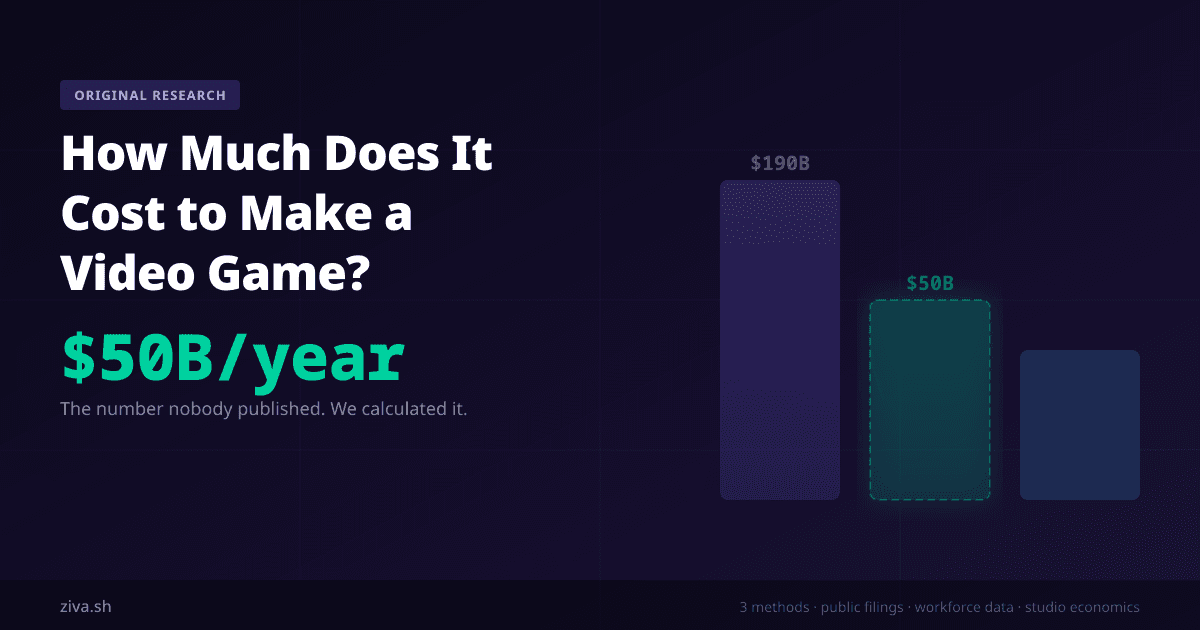
The global game industry spends roughly $50 billion per year on development (salaries, tools, infrastructure, outsourcing). This number does not exist in any published report.
We built it three ways using public company filings, workforce data, and studio-level economics. All three land in the same range.
The commonly cited “$190 billion gaming market” is consumer revenue, not production cost. If you are sizing a market on the cost side of games, $50B is your number.
The number that does not exist
Everyone tracks what players spend on games. Newzoo says $188.8 billion in 2025 . VGC says closer to $197 billion. Nobody tracks what it costs to make them.
The only published figure on the cost side is a $598 million “game development services” market from Kings Research, projected to hit ~$1.5 billion by 2032. That covers outsourced development work only. It says nothing about what studios spend internally, which is where almost all the money goes.
We needed this number for our own business planning and could not find it anywhere. So we calculated it.
Method 1: Public company filings
Several of the biggest game companies disclose R&D or development spending in their annual reports. Here is what we can verify with direct sources:
| Company | Annual R&D | Notes | Source |
|---|---|---|---|
| Electronic Arts | $2.57B | Game-only company | MacroTrends / EA 10-K |
| Tencent (total) | ~$9B | Gaming is ~50% of Tencent’s business; gaming R&D est. ~$4.5B | Statista / Tencent Annual Report |
| Sony (gaming segment) | ¥300B (~$2.13B) | Per Nikkei reporting; ~40% of Sony’s total R&D | VGChartz / Nikkei Asia |
| NetEase (total) | $2.46B | ~80% of NetEase revenue is gaming | MacroTrends / NetEase Filings |
| Take-Two Interactive | $1.005B | Game-only company (Rockstar, 2K, Zynga) | MacroTrends / Take-Two 10-K |
| Ubisoft | ~$1.1B | R&D investment expenditures | Ubisoft H1 FY25 Earnings |
| Microsoft (total) | $32.5B | Gaming is one segment; gaming-specific R&D not disclosed | MacroTrends / MSFT 10-K |
Adding only the gaming-specific or gaming-majority figures (EA + Tencent gaming est. + Sony gaming + NetEase + Take-Two + Ubisoft), we get roughly $13.7B from 6 companies alone. Microsoft’s gaming R&D is additional but not broken out from their $32.5B total.
These 6 companies are a fraction of the industry. Hundreds of other publishers (Capcom, Square Enix, Bandai Namco, Sega, Nexon, NCSoft, Krafton, Nintendo, Epic Games, Embracer, and many more) also spend billions collectively on development. Most are either private or do not separately report gaming R&D. Nintendo, for example, reports R&D under Japanese GAAP in its annual securities report but does not appear in US databases. Epic Games is private and discloses nothing.
If $13.7B comes from 6 companies that collectively earned roughly $85B in gaming revenue in their most recent fiscal years, and total industry revenue is ~$190B, then even a linear extrapolation puts total development spend at $30B+, before accounting for the fact that smaller studios typically spend a higher percentage of revenue on development than large ones with live-service cash flows.
Method 2: Workforce math
There are roughly 11.1 million game developers worldwide per SlashData, but that includes hobbyists. The professional, paid workforce is closer to 1 to 1.5 million. The U.S. alone has ~350,000 game industry jobs . The top 41 game employers collectively have 200,000+ employees, with Microsoft Gaming being the largest.
The U.S. figure of ~350K jobs comes from the Entertainment Software Association via Combine’s analysis. European and Asian figures are estimated from IGDA survey data and regional industry reports. Blended costs include salary, benefits, equipment, and office overhead. This method excludes part-time/hobbyist developers, outsourced non-game vendors (VFX, localization, motion capture), and marketing.
Method 3: Studio-level build-up
There are roughly 44,000 game developers on Steam according to VG Insights data reported by Game Developer. Most are hobbyists: 57% earned less than $1,000 in gross revenue. Filtering to professional studios and grossing up for non-Steam platforms (console, mobile, Epic, itch.io), industry data triangulates to approximately 25,000–30,000 professional studios worldwide.
We segmented these studios using VG Insights’ indie market taxonomy (adopted by Bain & Company), StudioKrew’s budget analysis , and country-level counts from ESA and UKIE :
| Tier | Studios | Avg team | Avg annual cost | Total spend | Key sources |
|---|---|---|---|---|---|
| AAA | ~200 | 300 | $100M | ~$20B | Public 10-Ks, Bain gaming report |
| AA | ~1,000 | 75 | $7.5M | ~$7.5B | VG Insights (~600 AA/AAA on Steam), StudioKrew |
| Mid-tier indie | ~3,000 | 25 | $3M | ~$9B | VG Insights “Triple-i” + “middle market” segments |
| Small indie | ~10,000 | 5 | $200K | ~$2B | VG Insights “small teams,” ESA, UKIE |
| Solo / micro | ~12,000 | 1 | $80K | ~$1B | IGDA Developer Satisfaction Survey, workforce estimates |
| Mobile (partial overlap) | ~5,000 | varies | $2M avg | ~$10B | data.ai industry estimates |
| Total | ~30,000 | $41B–$55B |
The range reflects uncertainty in average team sizes and loaded labor costs (salaries + benefits + overhead). AAA budgets now average $80M to $120M per StudioKrew, up ~20% from 2023. Some franchises far exceed this: Call of Duty budgets reportedly exceed $300M per Kotaku’s analysis of CMA documents, and the average AAA game cost ~$100M in 2024 according to a ResearchAndMarkets report.
Convergence
| Method | Range |
|---|---|
| Public filings (sourced companies + extrapolation) | $30B to $65B |
| Workforce × salary | $45B to $55B |
| Studio build-up | $41B to $55B |
| Central estimate | ~$50B/year |
This covers salaries, benefits, overhead, tools, engine licenses, servers, outsourced dev, and QA. It excludes marketing (which can double the number for AAA), hardware R&D, and platform/distribution fees.
Sanity check
$50B against ~$190B in consumer revenue is a 26% cost-to-revenue ratio. EA spent $2.57B in R&D against $7.6B in net revenue for FY2024, which is 34%. Take-Two spent $1.005B against $5.6B , which is 18%. A blended 26% across the full industry, including high-margin mobile games, is within that range.