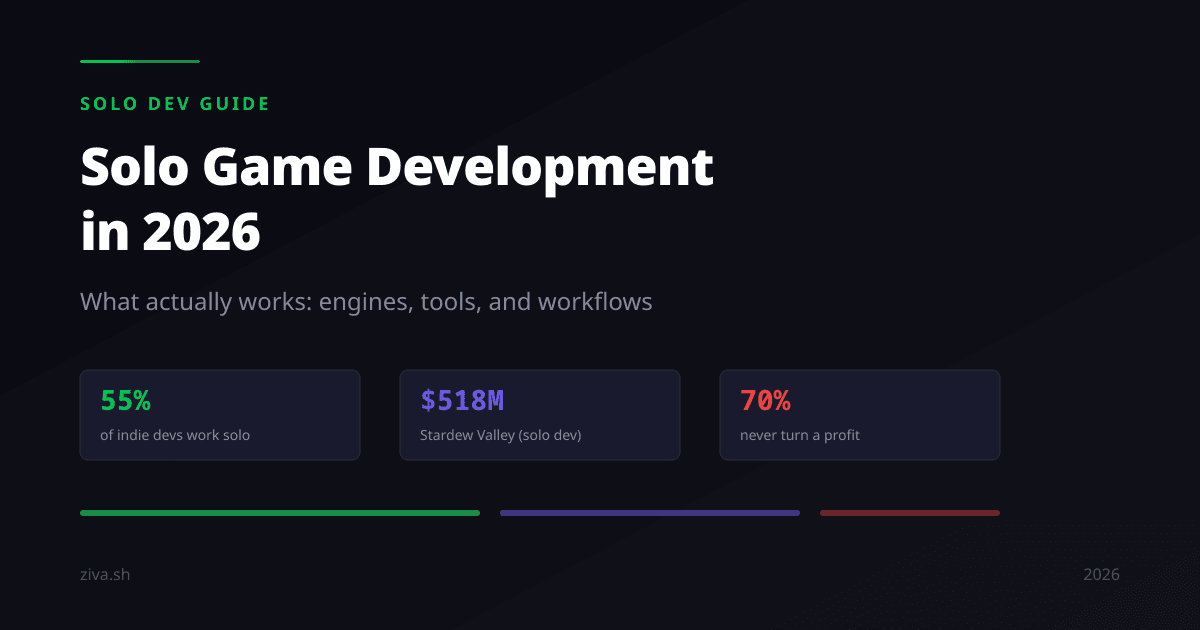
Solo Game Development in 2026: What Actually Works
55% of indie developers work solo. The failure rate is roughly 70%, but the ones who succeed often earn more per person than small teams.
Godot is the best engine for solo devs in 2026. Free forever, 120 MB download, text-based scene files that work with version control, and a scripting language you can learn in days.
Scope kills more solo projects than skill does. Buckshot Roulette (one mechanic, built in Godot, 8 million copies) beat most games with 10x the feature list.
Most solo devs fail. Some make millions.
About 55% of indie developers work solo , and roughly 70% of them never turn a profit. The median indie game on Steam earned $249 in 2025. That is not a typo.
But the outliers are extraordinary. Schedule I, a drug kingpin simulator built by solo developer TVGS, earned $151 million on Steam in 2025 and hit 414,000 concurrent players in its first weekend. Stardew Valley, built entirely by one person over 4.5 years, has sold 41 million copies for an estimated $518 million in gross revenue. Buckshot Roulette, a Godot game by solo dev Mike Klubnika, hit 8 million sales within a year of launch.
The gap between the median and the top is wider in solo development than in any other creative field. Understanding what the winners do differently is the point of this article.
Godot is the best engine for solo developers
Engine choice matters more for a solo developer than for a team. A team can absorb complexity. A solo dev cannot. Every hour spent fighting tooling is an hour not spent building the game.
Here is why Godot wins for solo work in 2026:
Zero cost, zero risk. Godot is MIT-licensed . No subscription, no revenue share, no runtime fee. You keep 100% of what you earn. When every dollar of development cost matters, paying nothing for your engine is a real advantage.
Text-based scene files. Godot stores scenes as .tscn text files. This means git diffs are readable, merges are possible, and you can track every change. Unity and Unreal use binary formats that make version control painful for solo developers who cannot afford to lose work.
120 MB editor. Download, unzip, run. No account, no installer, no waiting for asset reimports. Godot loads in seconds , which matters when you are iterating 20 times a day.
GDScript learns fast. GDScript reads like Python. Mike Klubnika, the Buckshot Roulette developer, switched from Unity to Godot in late 2023 and said: “It’s very fast, even in bigger projects. Generally I feel like it’s super quick to iterate on features.”
Game jam dominance. At the GMTK Game Jam 2025 , the largest jam on itch.io with 9,724 entries, Godot hit 39% of submissions, nearly matching Unity at 41%. Game jams are overwhelmingly solo devs, and they are choosing Godot. For a full engine comparison, see our Godot vs Unity breakdown.
Unity and Unreal are better choices if you need AAA-quality 3D rendering or official console export. But for solo 2D games and mid-complexity 3D projects, Godot gives you the fastest path from idea to shipped game.
Where your time actually goes
The hardest part of solo development is not any single discipline. It is doing all of them. A studio has separate people for programming, art, audio, design, QA, and marketing. A solo dev does every job.
Programming takes the largest share, but art and marketing are where most solo devs lose time or skip entirely. The games that break through on Steam almost always have a developer who invested in marketing before launch. Wishlists predict first-week sales, and wishlists come from months of showing your game to people.
Jacob Weersing shipped Bass Monkey on Steam in 18 months while working a full-time day job. His advice: triple your time estimates. If you think a feature takes a day, budget three.
Realistic timelines for solo development:
| Project type | Part-time (10-15 hrs/week) | Full-time |
|---|---|---|
| Game jam entry | 2-3 days | 2-3 days |
| Simple 2D game (5-10 levels) | 3-6 months | 1-3 months |
| Polished indie (Steam release) | 1-3 years | 6-18 months |
| Complex RPG or open-world | 3-5+ years | 1.5-3 years |
Eric Barone spent 4.5 years on Stardew Valley working 10 hours a day. That is the exception. Most solo devs who finish do it alongside a day job, in 1-2 years, by keeping scope tight.
The solo dev toolkit that actually ships games
The best solo dev workflow in 2026 is not the one with the most tools. It is the one with the fewest. Every tool you add is another thing to learn, maintain, and debug. Here is what works:
Engine: Godot 4. Free, fast, text-based files, GDScript for rapid iteration. If you need C#, Godot supports that too. See our beginner engine guide for alternatives.
Version control: Git. Non-negotiable. Solo devs lose work to corrupted files, accidental deletions, and broken builds more often than teams do because there is no one else to catch mistakes. Use Git, commit daily, push to a remote.
Art: Aseprite + free assets. Aseprite for pixel art, Kenney.nl for free CC0 assets, and AI image generators for concept art and placeholder sprites. Do not spend six months on art before you know if the game is fun.
Audio: Free libraries + AI generators. Freesound.org for sound effects, SOUNDRAW or similar for royalty-free music. Audio is the discipline solo devs most commonly outsource, and for good reason.
Project management: A text file. Trello, Notion, and HacknPlan all work, but the simplest system that you actually use is the best one. A markdown file in your repo with a checklist of remaining tasks keeps you honest about scope.
AI coding tools. Ziva works inside the Godot editor to generate GDScript, build scenes, and debug errors. GitHub Copilot and Cursor handle general coding. The point is not to replace your skills but to eliminate the friction of boilerplate, so you spend more time on game logic and less on wiring up UI nodes. For a full breakdown, see our AI tools for Godot guide.
Scope is the number one killer of solo projects
The pattern across every solo dev success story is the same: a small idea, executed well, shipped.
- Buckshot Roulette. One mechanic: a shotgun with live and blank rounds. Built in Godot. 8 million copies sold.
- Brotato. One mechanic: a potato with guns in a wave-based arena. Built in Godot. Over $10 million in revenue .
- Vampire Survivors. One mechanic: auto-attacking hordes while collecting upgrades. Solo dev Luca Galante. Over 10 million copies .
None of these games have complex narratives, branching dialogue, or realistic graphics. They have one core mechanic that is immediately fun, wrapped in just enough content to keep players engaged.
The solo devs who fail almost always fail on scope. They start an open-world RPG with a crafting system, skill trees, and 40 hours of quests. Two years in, they are 15% done and burned out.
A practical scope test: describe your game in one sentence. If you cannot, it is too big. Then list every feature and cut half of them. Ship what remains. Add the rest in updates if the game finds an audience.
How to not burn out
Solo game development is a burnout machine . You are the programmer, artist, musician, QA tester, marketer, and accountant. There is no team to share the load and no manager to notice when you are working 80-hour weeks.
What experienced solo devs recommend:
Keep your day job. 40% of indie devs work full-time on their games, but 60% work part-time while holding another job. IGDA surveys show one-third of self-employed indie devs earn less than $15,000 annually. Financial pressure makes burnout worse.
Set a schedule and stop. Work 2-3 hours a day on your game, five days a week. This is sustainable for years. Working 10-hour days is not. Barone did it for Stardew Valley and has said it was unhealthy .
Build in public. Share devlogs on Reddit, Discord, or social media. The feedback keeps you motivated, the audience builds your wishlists, and the accountability prevents you from quietly abandoning the project.
Ship something small first. Your first game will be your worst-performing one. Developer data shows a team’s third game averages $209,000 in gross revenue versus $120,000 for a debut . Treat your first release as paid tuition.
Start today, ship in six months
Here is the shortest path from zero to a shipped solo game:
- Download Godot (free, 120 MB, no account).
- Complete the Your First 2D Game tutorial (about 2 hours).
- Enter a game jam . Ludum Dare and GMTK Game Jam are good starting points. Build something in 48-72 hours.
- Pick a one-mechanic idea and build it over 3-6 months part-time.
- Upload to itch.io (free) or Steam ($100 fee). For the Steam process, see our Steam publishing guide.
The difference between solo devs who ship and solo devs who don’t is not talent. It is finishing. Pick a small game, pick a deadline, and build.
Published by the Ziva team. Ziva is an AI agent that works inside game engines to speed up development.