Godot vs GameMaker in 2026: A Data-Backed Comparison for 2D Developers
Godot is the better pick if you want zero cost, open source access, or plan to do any 3D work.
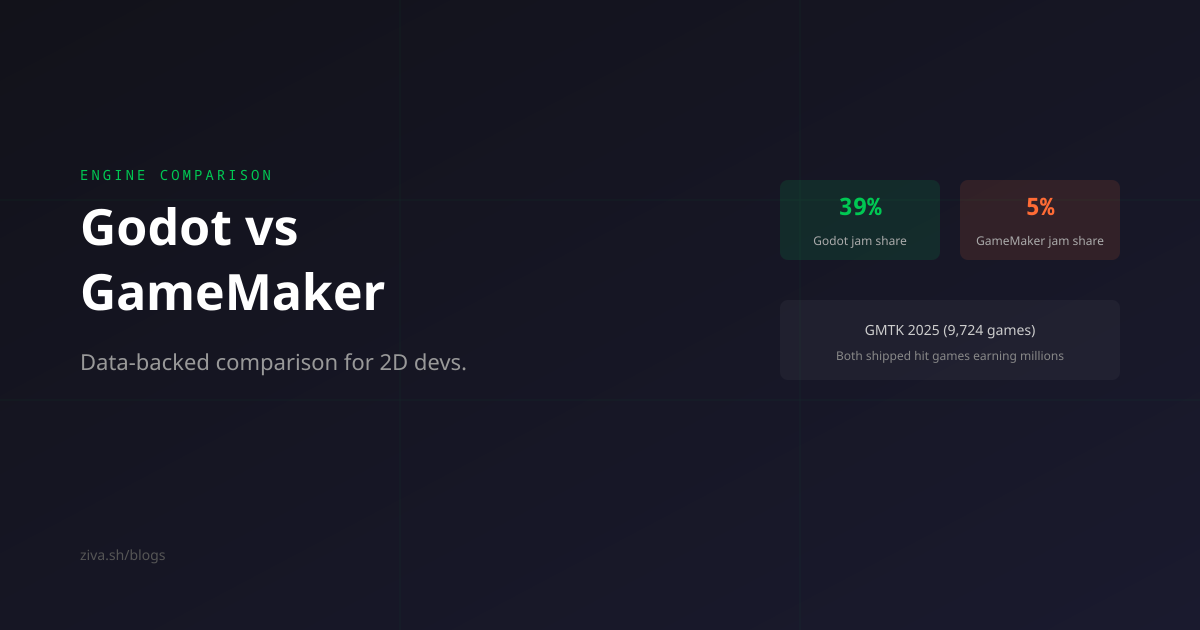
It went from 13% to 39% of GMTK Game Jam entries in four years. It costs nothing, ever.
GameMaker is the better pick if you want the fastest path to a playable 2D prototype and official console exports.
It has 25 years of 2D tooling, built-in sprite editing, and console support for $80/month.
Both engines have shipped hit games earning millions. Brotato (Godot) sold 10M+ copies. Katana ZERO (GameMaker) grossed ~$32M. The engine will not be the bottleneck.
Godot is growing faster. GameMaker is holding steady.
At the GMTK Game Jam 2025 , the largest jam on itch.io with 9,724 entries, Godot held 39% share and GameMaker held 5%. Four years earlier, Godot was at 13% and GameMaker was at 7%. Godot tripled; GameMaker stayed flat.
On Steam, both engines have small but meaningful market share. GameDiscoverCo data shows Godot at about 5% and GameMaker at about 4% of games released in 2024. Unity leads at 51%. At the February 2026 Steam Next Fest , Godot demos accounted for 9% of entries, up from nearly zero a few years ago.
The community numbers tell a similar story. Godot’s subreddit has ~307,000 members; r/gamemaker has ~94,000. Godot’s GitHub repository has 108,000+ stars and receives contributions from 500+ developers per release cycle. GameMaker is closed source.
None of this means GameMaker is dying. It means Godot is absorbing new developers faster, largely at the expense of Unity, while GameMaker retains a stable base of experienced 2D developers who already know GML.
Godot is free. GameMaker is cheap but not free.
Godot is MIT-licensed . No subscription, no revenue share, no per-seat fee, no commercial threshold. Ship a game that earns $50M and owe Godot nothing.
GameMaker restructured pricing in November 2023 , dropping monthly subscriptions for most tiers:
| Tier | Cost | What you get |
|---|---|---|
| Free | $0 | Non-commercial use. Desktop, web, mobile export. |
| Professional | $99.99 one-time | Commercial license. Same export targets. |
| Enterprise | $79.99/month | Commercial + console exports (PS, Xbox, Switch). |
For a solo dev keeping costs low, Godot wins outright: $0 vs $100+ for commercial GameMaker. For studios needing console exports, the comparison gets more interesting.
GameMaker Enterprise costs $960/year for all consoles . Godot’s console exports go through W4 Games , starting at $2,000/year for studios under $300K revenue or $10,000/year above that threshold. GameMaker’s console path is cheaper and more integrated.
GameMaker is built for 2D. Godot treats 2D as a first-class citizen.
Both engines are strong at 2D. The difference is philosophical.
GameMaker was designed from the ground up as a 2D engine. It has a built-in sprite editor , room-based level design, and 25 years of 2D-specific tooling. GameMaker’s own blog makes the case directly : “If you’re making a 2D game, there’s no engine on the market more finely-tuned to the needs of 2D game developers.”
Godot has a dedicated 2D renderer separate from its 3D pipeline. Pixel-perfect rendering, 2D physics, and tilemaps ship out of the box. Godot also does 3D, which GameMaker does not. If your project might evolve to include 3D elements, or if your next project could be 3D, Godot avoids a future engine switch.
Thomas Gervraud (Blobfish) made three commercial games in GameMaker before switching to Godot for Brotato. He wrote: “I owe a lot to that engine. It helped me get started with gamedev and make a living from it.” Brotato went on to sell 10 million copies .
GDScript is Python-like. GML is C-like. Both are learnable in a week.
GDScript uses Python-style indentation and is tightly integrated with Godot’s node system. GML uses C-style braces and semicolons, with a function library that mirrors GameMaker’s room/object model.
| GDScript | GML | |
|---|---|---|
| Style | Indentation-based | Braces and semicolons |
| Typing | Optional static typing | Typeless |
| OOP | Full inheritance via nodes | Object-based, no traditional inheritance |
| Performance escape hatch | C++ via GDExtension | YYC native compilation |
| Alternative languages | C#, Rust, C++ | JavaScript (experimental via GMRT) |
The practical difference: GDScript benefits from Godot’s scene system, where each node is a reusable class. GML benefits from GameMaker’s event system, where behavior is driven by step events, draw events, and collision events. Neither is harder to learn than the other.
Mike Klubnika, developer of Buckshot Roulette (8 million copies sold), switched from Unity to Godot and described the experience as having “not a lot of friction in experimenting or tweaking small things.”
For Godot-specific AI coding assistance, tools like Ziva can generate GDScript directly in the editor, which speeds up the learning curve for developers coming from other languages.
Both engines have proven commercial hits
GameMaker’s track record in 2D is deep. Katana ZERO grossed ~$32M . Hyper Light Drifter earned ~$14M . Undertale sold 5-10 million copies across platforms . Hotline Miami, Nuclear Throne, Chicory, Forager: the list of commercially successful GameMaker games stretches back over a decade.
Godot’s hit list is newer but growing fast. Brotato sold 10M+ copies . Buckshot Roulette hit 8 million sales . Dome Keeper earned ~$6.1M . Backpack Battles sold 640K units in its first month . And Godot can handle 3D too, which GameMaker cannot.
The takeaway: your engine choice will not limit your commercial potential. Both have shipped games that earned millions with small teams.
The decision tree
Pick Godot if:
- You want zero licensing cost, now and forever
- Your project might include 3D, or your next one might
- You want to read or modify engine source code (Halls of Torment developer Chasing Carrots used C++ via source access for performance-critical paths)
- You are on Linux (Godot runs natively; GameMaker’s Linux support has been inconsistent)
- You value a large, fast-growing community for support
Pick GameMaker if:
- You want the fastest possible time from zero to playable 2D prototype
- You need official, integrated console exports at a predictable price ($80/month)
- You already know GML and have existing GameMaker projects
- You want a built-in sprite editor and room-based level design without plugins
Either engine works well if:
- You are making a 2D game for PC and mobile
- You are a solo developer or small team
- You want to publish on Steam
- You care about how your game will earn revenue
If you are starting fresh with no engine experience and want the most flexibility for the least money, Godot is the safer long-term bet. It costs nothing, it does 2D and 3D, and its adoption curve is steeper than any other engine right now. But if you load up GameMaker and the room/object model clicks for you, trust that instinct. Both engines have shipped games that changed their developers’ lives.