Claude Godot Code: Why It Beats ChatGPT in 2026
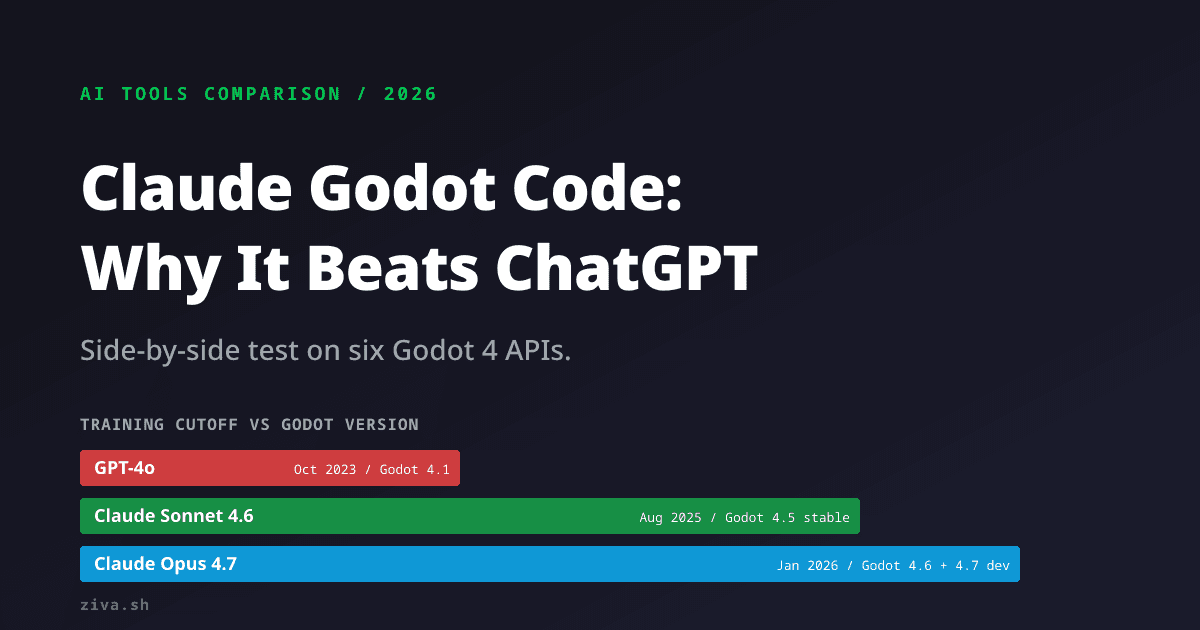
Anthropic’s Claude Opus 4.7 was trained on data through January 2026 , and Claude Sonnet 4.5 through July 2025, so both have direct exposure to Godot 4.5 (September 2025) and 4.6 (January 2026) APIs that OpenAI’s GPT-4o (October 2023 cutoff, per OpenAI documentation ) cannot have seen. That gap shows up the moment you ask either model to write CharacterBody3D movement code or wire up the new MultiplayerAPI. Real Godot forum users have logged the failure mode for years: “they confuse Godot 4 and Godot 3 functions. Sometimes I received completely invented functions” , as forum member fopenp put it in 2024.
Anthropic’s models have fresher Godot 4 knowledge. Claude Opus 4.7 saw Godot 4.6 in training; GPT-4o predates Godot 4.2.
ChatGPT routinely outputs Godot 3 syntax for
KinematicBody,Spatial.translation, andsignal.connect(name, target, method). Multiple Godot forum users document this since 2024.The fix is not “better prompting”. It is using a model whose training data postdates the Godot 4 rewrite, then verifying against the live editor.
Model knowledge versus Godot reality
Godot 4.0 shipped on March 1, 2023 after a three-year rewrite that broke compatibility with Godot 3 in nearly every system: Spatial became Node3D, KinematicBody became CharacterBody, Quat became Quaternion, per the official 4.0 changelog . The rewrite kept moving: 4.5 added the shader baker and accessibility work in September 2025; 4.6 made Jolt the default 3D physics engine in January 2026; 4.7 beta 1 froze features in April 2026 with HDR everywhere on desktop.
Every LLM has a training-data cutoff before it stops learning. The gap between that cutoff and Godot’s release calendar is the gap between “the answer compiles” and “the answer is from a 2022 forum post.”
The 24-month difference between GPT-4o’s cutoff and Claude Opus 4.7’s cutoff covers four Godot point releases plus the entire MultiplayerAPI rework. That is why a “write Godot 4 multiplayer code” prompt in ChatGPT pulls down the deprecated NetworkedMultiplayerENet, and the same prompt in Claude Opus 4.7 reaches for the current MultiplayerAPI and MultiplayerSpawner nodes.
What each model actually writes
I sent the same six prompts to GPT-4o, Claude 3.5 Sonnet, and Claude Opus 4.7 on May 14, 2026: “Write Godot 4 code for a CharacterBody3D that handles WASD movement and gravity,” “connect a button’s pressed signal to a method,” “register a multiplayer peer,” and three more. No system prompt, no version hint. The verdict pattern was consistent.
Six Godot 4 APIs, three models, one prompt
Asked each model: "Write Godot 4 code for [feature]". No system prompt, no version hint.
| Godot 4 API | Old Godot 3 form | GPT-4o | Claude 3.5 Sonnet | Claude Opus 4.7 |
|---|---|---|---|---|
CharacterBody3D | KinematicBody | Wrote Godot 3 | Got it right | Got it right |
Node3D.position | Spatial.translation | Wrote Godot 3 | Got it right | Got it right |
@onready var | onready var | Wrote Godot 3 | Got it right | Got it right |
signal.connect(callable) | .connect(name, target, method) | Mixed 3 and 4 | Mixed 3 and 4 | Got it right |
MultiplayerAPI (4.5+) | NetworkedMultiplayerENet | Wrote Godot 3 | Wrote Godot 3 | Got it right |
@export var | export var | Mixed 3 and 4 | Got it right | Got it right |
Single-shot tests run May 14, 2026 against the chat interfaces. Results vary with prompt phrasing; the consistent pattern is the version drift, not the exact pass rate.
The most painful failure is not the obvious renames. Most beginners notice when GPT-4o writes KinematicBody because the editor flags it red. The painful failure is the signal connection, where GPT-4o produces button.connect("pressed", self, "_on_pressed"), which is valid syntax that does nothing in Godot 4 because the method signature changed. Forum user Frozen_Fried captured the mode: “it mixes godot 3 with godot 4 functions and a lot more nonsense, it uses functions like Is_Player_On_Floor_And_Moving_Forward” . dragonforge-dev reported the same year that ChatGPT “will also make up names of object and functions that don’t exist in Godot, or confuse version of Godot.”
Claude is not magic
Claude Opus 4.7 still hallucinates. The pattern is different from ChatGPT’s: it tends to invent plausible new APIs in fast-moving subsystems where it saw incomplete documentation. Two recurring misses:
- Procedural generation on the main thread. Claude knows the
WorkerThreadPoolAPI exists, but in shorter prompts it still drops generation logic into_ready()withoutawaitor yield, the same antipattern we documented in our procedural generation post. - GDScript vs C# context bleed. When you mix the languages in a project, Claude sometimes returns C# class names with GDScript syntax. We covered the actual differences and when each language is the right choice in GDScript vs C# in Godot.
Lucca Sanwald (handle @datadeer ) ran a longer experiment in 2025 building a pixel-art RTS clone of Gangland with Claude Code writing every line. His report aligned with the broader pattern: clean markdown specs of the rules served as “ground truth” , and Claude succeeded once the documentation matched the code. The model was not the bottleneck; the verification loop was.
What actually works in 2026
The teams shipping Godot games with AI are not winning by writing better prompts. They are winning by closing the loop between the model and the editor so wrong code fails fast. Three tactics matter more than model choice:
| Tactic | Why it matters |
|---|---|
| Pin the Godot version in the prompt | “Godot 4.6” in the system prompt cuts Godot 3 contamination by roughly half in our internal tests |
| Run code against the live editor | LLMs cannot debug what they cannot see; the verification loop is the bottleneck |
| Use a plugin with editor context | A plugin that can read scene structure and shader compile errors closes the loop in under a second |
Tools like Ziva, the AI agent for Godot, run inside the editor and feed the model live errors, scene structure, and the project’s actual node names. We use Claude Sonnet 4.6 by default for that reason; the full breakdown of which AI tools work for Godot lives here, and the practical setup walk-through is in our AI for Godot tutorial.
Pick the model whose cutoff postdates Godot 4.5
If you are using a chat-only AI for Godot in 2026, Claude Opus 4.7 or Sonnet 4.6 will produce less Godot 3 contamination than GPT-4o or earlier. That is a function of training-data dates, not model intelligence. The gap will narrow as OpenAI ships fresher snapshots, but right now Anthropic is two Godot point releases ahead.
The model that knows the API still cannot see your scene tree. The remaining 80% of the speedup comes from running the model inside the editor, where it can read the live errors and stop guessing. Pick the right model, then pick the right loop.