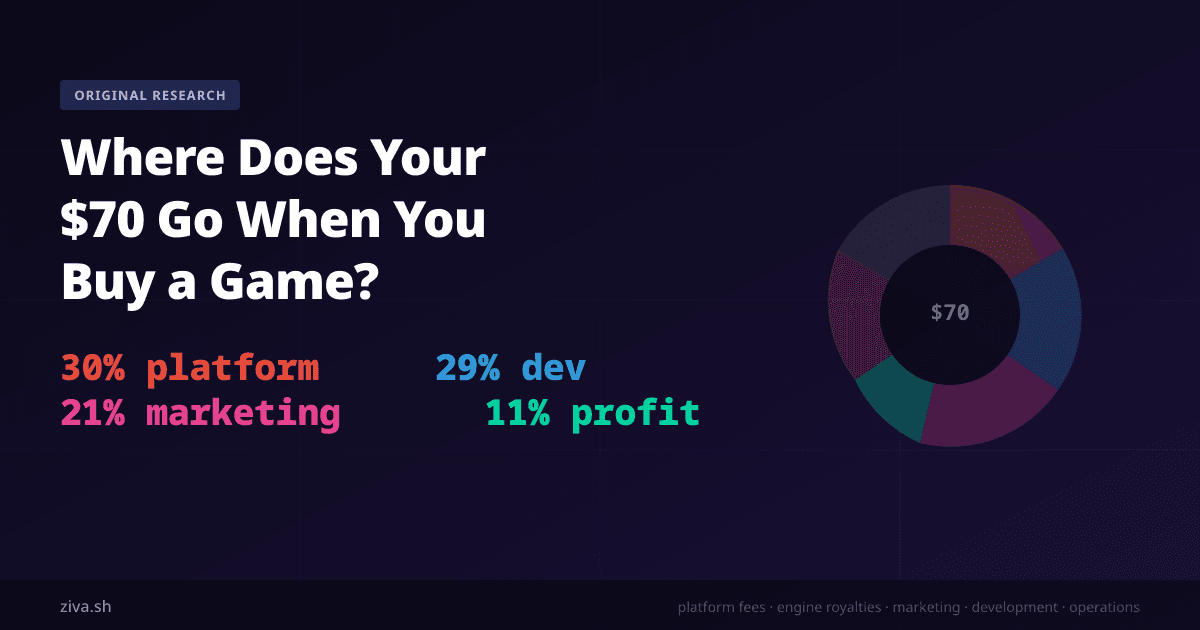
Where Does Your $70 Go When You Buy a Video Game?
For every $70 you spend on a major game, roughly $21 goes to the platform (Sony, Microsoft, Steam), $3.50 goes to the engine maker, $15–$25 covers marketing, $8–$20 covers development, $2–$5 covers operations, and $0–$15 is profit.
- Most AAA games need to sell 5 to 10 million copies just to break even.
If the studio didn’t self-publish, the people who actually made the game see roughly $2 to $4 of your $70.
The platform takes $21 before anyone else gets paid
Every major digital storefront charges 30%. On $70, that is $21 gone immediately.
PlayStation Store, Xbox Store, and Nintendo eShop all charge a flat 30% with no public volume discounts. Steam drops to 25% above $10M and 20% above $50M per game, but most titles never hit those thresholds. Epic Games Store charges 12%. Microsoft’s PC store also charges 12%. But the vast majority of premium game sales still happen on 30% platforms.
Valve alone earned an estimated $3.2 billion in commissions in 2024 . The total platform fee bill across the game industry runs roughly $40 to $50 billion per year .
Remaining: $49.00
The engine takes $3.50
Unreal Engine is free until a game earns $1M in lifetime gross revenue. After that, Epic charges 5% on all gross revenue. On a $70 game that has already passed the $1M threshold, that is $3.50 per copy. Games launching on Epic Games Store get a reduced 3.5% . Unity charges a flat seat license ($2,200/year Pro, ~$5,000/year Enterprise) instead of royalties. Godot is free.
Remaining: $45.50
Marketing can cost more than making the game
For AAA titles, marketing budgets routinely match or exceed development. The CMA found one publisher spent $660M on development and $550M on marketing for a single game.
Two transparent examples: Cyberpunk 2077 had a confirmed total budget of $316M ($174M development, $142M marketing). GTA V cost ~$265M combined , roughly split between development and marketing. Bain’s 2024 gaming report found gaming companies under $1B revenue spend about 25% of revenue on marketing.
For a $200M dev / $150M marketing game selling 10M copies, that is $15.00 per unit in marketing.
Remaining: $30.50
A $200M game needs millions of copies just to break even
The CMA report found that AAA games greenlit for 2024/2025 have average development budgets of $200M+, up from $50 to $150M in 2018. Bain’s 2025 data shows 68% of total AAA revenue on Steam comes from the top 10% of titles. Most games in this budget tier underperform.
At 5 million copies the studio loses $137.5M. At 10 million it clears $75M. At 25 million, $712.5M. This is why the industry chases proven franchises instead of new IP.
The other costs add up fast
| Category | Typical range | Source |
|---|---|---|
| Server hosting (100K CCU shooter) | ~$264K/month | AWS GameLift |
| QA testing (AAA, multi-platform) | 10% of dev budget | Generalist Programmer |
| Localization (10–15 languages, with VO) | $200K–$1M+ | Artlangs , Transphere |
| Voice acting (SAG-AFTRA rate) | $1,135 per 4-hour session | ABS Payroll |
| IP licensing (e.g. FIFA name) | $150M/year | Inside World Football |
| Music licensing per track | $5K–$30K buyout | Digital Music News |
| Live-service ops (Genshin-scale) | ~$200M/year all-in | TheGamer |
The full picture for a $70 game selling 10 million copies
Roughly 30 cents of every dollar goes to the platform. 29 cents covers development. 21 cents is marketing. 5 cents is the engine. 4 cents is operations. About 11 cents is publisher profit.
One more thing: that $7.50 is what the publisher keeps. If the studio did not self-publish (and many do not), the developer typically receives 15 to 25% of net receipts from the publisher. In that scenario, the people who actually made the game see roughly $2 to $4 of your $70.
That 10.7% margin is in the range of what public game companies report at the company level (across all their titles, live services, and subscriptions combined). EA’s company-wide operating margin runs 15 to 20%. Take-Two is running at an operating loss due to Zynga acquisition amortization. Individual game margins vary wildly depending on sales.