How to Write a Game Design Document That You Will Actually Use
A game design document (GDD) is a written plan for your game. Its job is to prevent scope creep and keep you focused.
For solo developers and small teams, a one-page GDD works better than a 50-page spec. Write it in a tool you already use (Notion, Google Docs, a markdown file).
The document should be alive. Update it when your design changes. A GDD that does not match the game is worse than no GDD at all.
A game design document does one thing: it forces you to decide what your game is before you start building it. Think of it as a compass, never a contract. The final game will look different from the document, and that is fine. The value is in the planning, not the plan.
Most advice on GDDs comes in two flavors: academic templates with 20+ sections you will never fill out, or vague “just write your vision” posts with no structure at all. This guide is neither. It covers what actually belongs in a GDD for a solo or small-team indie game, what to leave out, and how to keep the document useful after day one.
Why 50-page GDDs fail
Gemma Ellison, a game designer who documented her experience with large GDDs, describes a case where an engineer built an entire character customization system based on an outdated section of the GDD. The work was scrapped. On another project, a 500-page design bible was abandoned entirely because nobody could keep it current.
This pattern repeats across the industry. The document becomes too long to maintain, falls out of sync with the actual game, and the team stops reading it. At that point, you have the worst of both worlds: time wasted writing a document nobody uses.
The fix is scope. A GDD for a solo indie project does not need 20 sections. It needs five.
Five sections that matter
Here is what belongs in a GDD for a solo or small-team indie game:
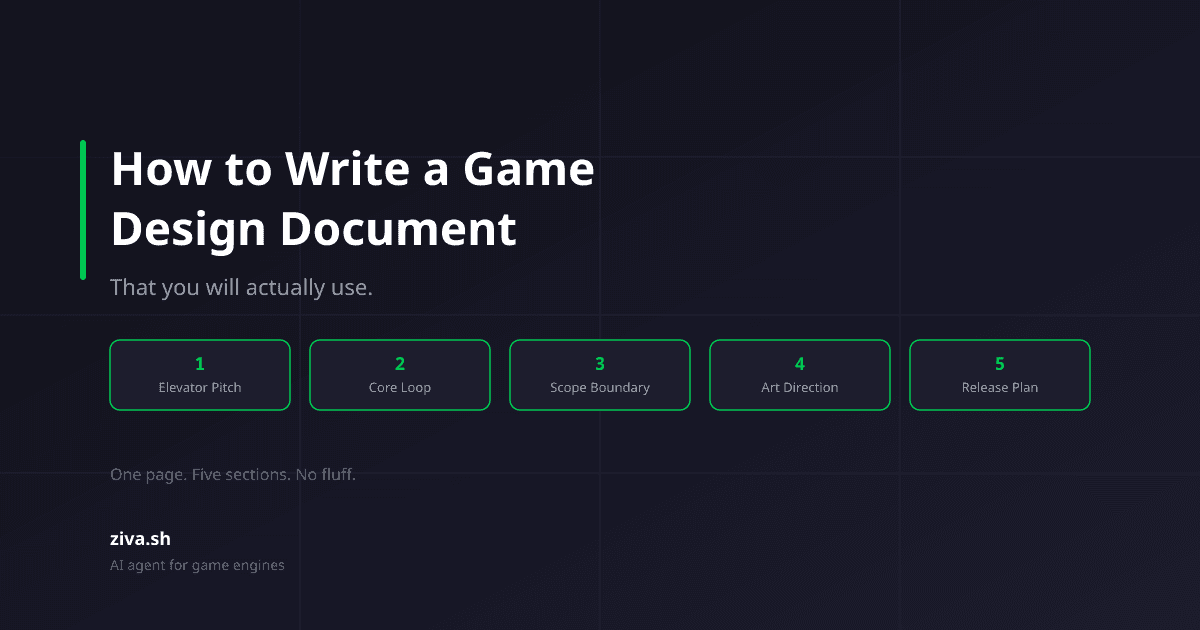
1. Elevator pitch (2 sentences). What is the game, and why would someone play it? If you cannot say this in two sentences, your concept is too vague. Example: “A roguelike where you play as a potato with six weapon slots. Runs last 10 minutes. The hook is absurd build variety.” That is Brotato , a game with over 10 million sales .
2. Core loop (1 paragraph). What does the player do every 30 seconds? What is the reward cycle? This is the single most important section because it defines what you are prototyping first. If the core loop is not fun with placeholder art, no amount of polish will save the game.
3. Scope boundary (a list of what is OUT). This section prevents scope creep. Write down the features you will NOT build. “No multiplayer. No procedural generation. No crafting system. Five levels maximum.” Every feature idea that comes up during development gets checked against this list. If it is on the “out” list, you do not build it unless you remove something else.
For context on why scope matters: solo indie games take 3 to 6 months part-time for a simple 2D game, and every feature you add extends that timeline. Our analysis of game development costs found that even small scope increases compound fast.
4. Art and audio direction (3 to 5 reference images or links). Do not write paragraphs describing your visual style. Paste reference images. Link to games with a similar look. Name the color palette. This is faster to create, easier to follow, and harder to misinterpret.
5. Target platform and release plan (1 paragraph). Where will you publish? What is the price? What is the minimum viable version? Mike Klubnika launched Buckshot Roulette on itch.io for $1 and sold 4 million copies. Dominik Babiarz launched Yerba Mate Tycoon at $1.54 average with 1,516 wishlists. For data on how pricing affects indie revenue, see Where Does Your $70 Go. Know your target before you start building.
That is the whole document. Five sections. One page. If your GDD is longer than one page before you have a playable prototype, you are over-planning.
Sections you do not need yet
These sections appear in most GDD templates. Skip them until you have shipped a prototype and confirmed the core loop is fun:
- Detailed narrative and dialogue scripts. Write these during production, not pre-production.
- Full level designs. Design levels as you build them. Paper sketches are fine early on.
- Marketing plan. Worry about marketing after you have something to show. For Steam launch strategy, see How to Publish a Game on Steam in 2026.
- Technical architecture. Unless you are building a custom engine, your engine handles this. If you are using Godot or Unity, the architecture is already decided.
- Monetization deep-dive. Decide “premium” or “free-to-play” in your release plan section. The rest can wait. For revenue data to inform your pricing, see How Much Do Indie Games Actually Make on Steam.
How to maintain the document
A GDD that does not match the game is actively harmful. Here is how to keep it current:
Put the document where you already work. If you use Notion, put it in Notion. If you use markdown, put it in your game repo. If it is in a separate tool you never open, it will rot.
Review it when your design changes. When you cut a feature or add a mechanic, update the GDD the same day. This takes 5 minutes and saves hours of confusion later. Ellison’s lean GDD framework recommends weekly reviews even for solo developers.
Version it. If you use Git for your game project (and you should), your GDD markdown file gets versioned for free. You can see exactly when and why you changed direction.
Real GDDs you can study
Several famous game design documents are publicly available :
| Game | What you can learn |
|---|---|
| The Doom Bible | How id Software (about 6 people at the time) scoped an FPS that defined a genre. |
| Narbacular Drop | The Portal predecessor. A student project GDD that led to a Valve acquisition. |
| Deus Ex design doc | Warren Spector’s design philosophy in document form. Detailed but readable. |
| Rogue Legacy design notes | Scope control in a roguelike. Shows how constraints drive creativity. |
All of these are available at Game Docs , an archive of public design documents from shipped games.
Start writing yours
Copy this into a markdown file, Notion page, or Google Doc:
# [Game Name]

## Pitch
[Two sentences: what is the game, why would someone play it?]

## Core Loop
[What does the player do every 30 seconds? What is the reward?]

## Out of Scope
- [Feature you will NOT build]
- [Feature you will NOT build]
- [Feature you will NOT build]

## Art Direction
[Paste 3-5 reference images or links here]

## Release
- Platform: [itch.io / Steam / mobile]
- Price: [$0 / $5 / $15]
- Minimum viable version: [What ships in v1?]
If you already have a game idea from following our beginner guide, filling this out should take under an hour. If it takes longer, your scope is too big for a first project. Cut until it fits on one page.