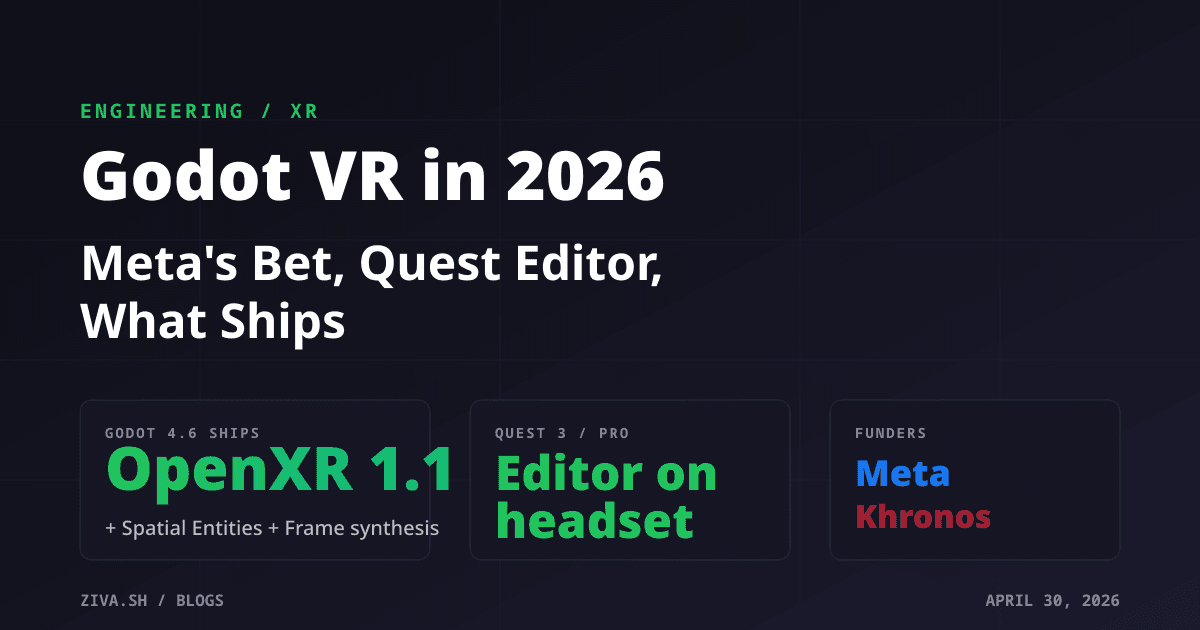
Godot VR in 2026: Meta's Bet, Quest Editor, What Ships
Two organizations rewrote Godot’s XR story by funding it. Meta has paid W4 Games (the studio founded by Godot co-creator Juan Linietsky and project manager Rémi Verschelde) since 2024 to improve Quest and OpenXR support. The Khronos Group has funded the Godot OpenXR Integration Project led by Bastiaan Olij , which shipped Render Models in 4.5 and Spatial Entities in 4.6.
Godot 4.6, released January 26, 2026 , brings OpenXR 1.1 with automatic 1.0 fallback , Spatial Entities for anchors and plane detection, frame synthesis with depth buffer, and a Khronos-loader APK that runs on Quest, PICO, HTC, and Samsung Galaxy XR from one build artifact.
The Godot editor now runs natively on Quest 3 and Quest Pro through the Meta Horizon Store , with full GDScript editing, debugging, and immediate VR preview. Quest 2 is excluded because of RAM. No other major engine ships an editor that runs on a consumer headset.
Best fit: indie 6DoF Quest titles, Galaxy XR launch content, AR with anchors, game jams. Wrong fit: social-VR platforms (VRChat is Unity, Resonite uses FrooxEngine with a Unity renderer), and AAA-style photoreal PCVR where Unreal still leads.
Why Godot stopped being a “no” for VR
Telling someone in 2023 to build a Quest game in Godot was a hesitant recommendation at best. The OpenXR support was, in VR.org’s words, “rudimentary, poorly optimized, and lacks many of Quest’s more advanced feature extensions” , and the documentation was sparse. That changed because two organizations started writing checks.
The Meta arrangement is unusual because the contractor is not a third party. W4 Games is the commercial arm of the same people who run Godot. Juan Linietsky co-created the engine. Rémi Verschelde is its project manager. Fabio Alessandrelli maintains networking . Money paid to W4 lands in upstream Godot under the hands of people who can merge their own work.
The Khronos Group’s contribution is more conventional: standards-body funding to keep a major open-source engine current with OpenXR. Nihav Jain, a Senior Software Engineer at Google, said the Godot OpenXR Integration Project “was critical for the spatial entities effort” and that timely feedback validated the design of the extensions. That is Google describing Godot as a working group member.
What Godot 4.6 actually ships for XR
The combined output landed in Godot 4.6 on January 26, 2026 . The XR-relevant parts are concrete and named.
The single-APK story matters more than it sounds. Before 4.6, shipping the same game to Quest, PICO, and HTC required separate builds, separate signing keys, and separate store uploads on independent update cadences. Godot 4.6 embeds the Khronos OpenXR loader so that, in theory, one APK deploys to any compatible headset . For a one-person team working across Quest 3 and a Galaxy XR review unit, that collapses three pipelines into one.
The Spatial Entities work is the part that matters for AR and mixed reality. Spatial anchors mean an object placed in the user’s living room stays put between sessions. Plane detection picks up floors, walls, and tabletops. Marker tracking spots a printed QR code and uses it as a positional reference. Shuai Liu, PICO’s OpenXR Tech Lead, said: “We are very pleased to see Godot adding support for RenderModel” , which is the headset team behind the second-largest standalone VR platform endorsing Godot’s implementation by name.
Frame synthesis is where the runtime performance trick shows up. Meta states that Application SpaceWarp gives apps “roughly 70% more power to work with compared to rendering at full framerate” . The application renders at half the headset’s refresh rate, supplies a depth buffer and motion vectors, and the system synthesizes the missing frames. Godot 4.6 supports the depth and motion vector outputs ASW needs.
You can write Godot games inside the headset
The change that broke containment with developers outside the Godot bubble is the editor itself running on Quest 3 and Quest Pro as a hybrid app. It ships through the Meta Horizon Store and was originally built on the Android editor port by Meta engineer Fredia Huya-Kouadio, with assistance from W4 Games and proof-of-concept work by Bastiaan Olij .
Feature parity with desktop is real. GDScript editing with code completion. Live scene editing, live script reloading, live debugging, live profiling. Bluetooth keyboard support, virtual keyboard fallback, direct touch, and Theater View. Asset library access. Multi-platform binary export from inside the headset.
The iteration loop is what saves time. Per UploadVR, “if you’re using it to make a VR game, clicking play to test will transition into immersive mode almost immediately, significantly reducing the time and friction involved in testing VR compared to using the editor on desktop” . Anyone who has alt-tabbed between Visual Studio, a desktop tether, and a sweaty headset for a 30-second iteration loop knows what that sentence means in real wall-clock time.
Quest 2 is excluded because it lacks the RAM . The Quest 3S is expected to work. With Horizon OS v69’s Seamless Multitasking, developers can keep the editor open in a panel while the game runs in immersive mode and watch live edits reflect in real time.
This feature does not exist on Unity or Unreal. It is the first time a mainstream game engine has shipped an editor that runs on a consumer VR headset, and for any developer choosing engines in 2026, that is a real differentiator.
What headsets Godot targets in 2026
Headset coverage is broad because OpenXR is the contract. The same Godot project deploys across Meta, Samsung, HTC, PICO, and Valve hardware with build-target changes only.
Samsung Galaxy XR launched October 21, 2025 at $1,799 with dual 3,552 x 3,840 micro-OLED displays and the Snapdragon XR2+ Gen 2 chipset . Google’s Android XR documentation lists Godot as a supported development path alongside Android Studio, Unity, and Unreal . For a small studio shipping to Quest, Galaxy XR, and Steam Deck simultaneously, Godot is now the only engine where one APK plus one Linux ARM64 binary covers everything without per-platform license tiers.
Real Godot VR games on the platform
The honest answer is that the catalog is mostly indie and itch.io. Open Saber, Voxel Works Quest, While Waiting, Gut Grease, Pizza Panic, dashton, Fugitive 3D, and Paddle Frog VR are the visible Godot VR titles tagged on itch.io . The Godot editor itself is now a Horizon Store listing. The forthcoming Godot XR Game Jam V starts in March 2026 , run on the official Discord XR channel.
Voxel Works Quest by NeoSpark314 is a useful case study : a procedural infinite voxel world prototype with jog-in-place locomotion, built on the Godot Oculus Quest Toolkit. The author has paused active development, but the project shipped, ran on the headset, and demonstrated mining mechanics with controller swing detection on Quest hardware using Godot 3.x infrastructure that was a fraction of what 4.6 ships today.
The thinness of the catalog is the honest part of the story. There is no Godot equivalent of Beat Saber yet. What changed in 2026 is that the production tooling caught up: a developer starting a commercial VR title in Godot today has access to the same OpenXR feature set as a Unity team, without per-seat licensing or Runtime Fee anxiety. The shipped catalog is a leading indicator, not a verdict, and our broader writeup on Godot’s growth across all platforms puts the macro trajectory in context.
Where Godot XR is still the wrong choice
Three categories where Unity or Unreal still win.
Social VR platforms. VRChat runs on Unity . Resonite is built on the custom FrooxEngine, which uses Unity as its renderer . The avatar pipelines, asset bundle systems, live moderation tooling, and user-generated-content runtime in those platforms are years ahead of anything open source. If you are building a VRChat-class experience, Godot is not the right engine.
Photoreal AAA-style PCVR. Unreal’s offline-quality renderer, Nanite, and Lumen have no current Godot equivalent. Godot 4.6 added Jolt Physics as default and 4.7 ships ray-tracing groundwork , but a single-developer Godot project will not hit Asgard’s Wrath 2 fidelity. Pick the right tool.
Quest 2 and older targets. Quest 2 still has install base, but the editor will not run there, several Spatial Entities features only matter on color-passthrough headsets, and Application SpaceWarp’s full benefit assumes the post-Quest-3 hardware generation. If your audience is locked on Quest 2, Unity’s mature pipeline is the safer choice.
Practical first 30 minutes
Install Godot 4.6 stable. Open the Project Setup Wizard from the Tools menu — it ships in 4.6 specifically to handle XR project configuration , including target headset vendor, render pipeline (Forward+ or Mobile), and OpenXR Vendor Plugin install. Choose Quest 3 if you have one, otherwise Galaxy XR or Steam Frame.
For controller and locomotion code, start from godot-xr-tools , the production-ready component library. It covers locomotion, grabbing, pointing, and climbing, and avoids reinventing them from scratch unless your gameplay genuinely requires custom physics.
For AI assistance during the build, Ziva is the Godot-native plugin that runs Claude, GPT, and Gemini inside the Godot editor itself. It can read your scene, write GDScript, and iterate on shader and tool logic without alt-tabbing. Pair it with the Quest 3 standalone editor for a first iteration loop on the headset, and there is genuinely no faster way to ship a 6DoF prototype right now.
Godot’s XR support is not perfect, and several platforms — Quest 2, social-VR competitors, AAA PCVR — still belong to Unity or Unreal. What is true in mid-2026 is that the indie XR sweet spot, where most Quest and Galaxy XR developers actually live, is now well served by an engine that costs nothing, ships its source, and is being actively improved by the people who built it on someone else’s payroll.