Godot Multiplayer in 2026: What Actually Works
Dome Keeper, a Godot game with $6.1 million in Steam revenue , is shipping online multiplayer on April 13 . The developers at Bippinbits added both local and online co-op plus competitive modes to an existing codebase of tens of thousands of lines of GDScript. They presented the process at GodotCon 2025 , which means there’s now a real production case study for Godot multiplayer.
This matters because the most common question on the Godot forums about multiplayer is whether the engine can handle it at all. The answer is yes, with caveats. Here’s what you get, what you don’t, and what to do about the gaps.
What Godot ships out of the box
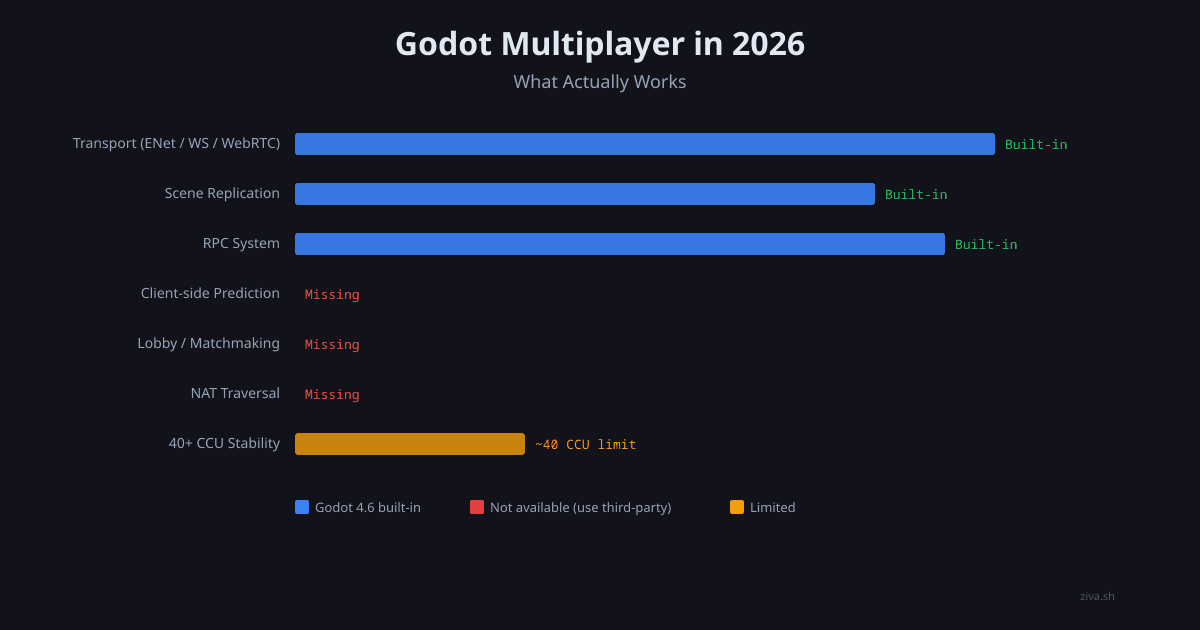
Godot 4.6 includes a high-level multiplayer API built around three transport options:
ENetMultiplayerPeer is the default. It wraps the ENet library over UDP with reliable and unreliable channels, packet sequencing, and bandwidth management. It supports both client-server and mesh network topologies .
WebSocketMultiplayerPeer uses WebSocket over TCP. This is the option for HTML5 exports where UDP is unavailable. The tradeoff is higher latency from TCP’s guaranteed delivery.
WebRTCMultiplayerPeer enables peer-to-peer connections. It works natively in HTML5 builds but requires a GDExtension plugin on desktop platforms. You also need to run your own signaling server.
On top of these transports, Godot provides two scene replication nodes introduced in Godot 4.0 :
MultiplayerSpawnerhandles remote instantiation of scenes across peersMultiplayerSynchronizerreplicates node properties automatically
These nodes let you prototype multiplayer without writing networking code. Add a MultiplayerSynchronizer to a player scene, configure which properties to sync, and position data flows to all connected peers. The @rpc annotation on functions handles remote procedure calls with configurable authority, transfer mode, and call behavior.
For a hobby project or a jam game, this stack is enough to get two players connected and syncing state in an afternoon.
What’s missing for production games
The gap between “works in a prototype” and “ships to paying customers” is where Godot’s multiplayer gets honest.
No client-side prediction or rollback. When a player presses a movement key, the input goes to the server, the server processes it, and the result comes back. The player’s character doesn’t move until the round trip completes. Unity’s Netcode for GameObjects and Fish-Net provide client-side prediction with lag compensation. Godot has none of this built in. There’s no rollback netcode either, which matters for fighting games and fast-paced action. Rivet’s engineering team called this a deal-breaker for serious multiplayer development.
Limited data synchronization. MultiplayerSynchronizer handles primitives and built-in types. If you need to sync inventories or complex data structures, you’re manually encoding and decoding PackedByteArray. Unity’s Fish-Net provides SyncList and SyncDictionary types that handle this automatically. Godot developers end up writing repetitive serialization code that Fish-Net eliminates.
No built-in lobby or matchmaking. Godot provides transport and replication. Everything above that is your problem: player authentication, lobbies, matchmaking, friend lists. Unity ships a multiplayer service with server hosting included.
No NAT traversal. ENet uses UDP, and most home routers block incoming UDP. You need either a relay server or Steam Networking to get players connected without port forwarding. Godot ships neither.
Scalability ceiling. Rivet’s tests showed connection stability issues above roughly 40 concurrent users per server, while Fish-Net benchmarks exceeded 100 CCU without problems. If your game needs more than a few dozen players per session, you’ll hit this wall.
Third-party tools that fill the gaps
The Godot ecosystem has grown around these limitations:
GodotSteam wraps Valve’s Steamworks SDK, giving you Steam Networking Sockets (relay servers, NAT traversal) plus lobbies with matchmaking and friends lists. If you’re shipping on Steam, this is the most battle-tested option. It integrates as a MultiplayerPeer , so your existing RPC and replication code works unchanged.
GD-Sync is a Godot-specific multiplayer plugin that provides lobbies with matchmaking and hosted servers out of the box. It targets indie developers who want the Unity-like “it handles the infrastructure” experience without leaving Godot.
For C# developers, libraries like LiteNetLib and DarkRift 2 bypass Godot’s built-in networking entirely. The Godot forums recommend this approach for anyone building a dedicated server in C#, since calling between GDScript and C# has performance overhead that makes it impractical for high-frequency network updates.
Nakama is an open-source game server that handles authentication with matchmaking, leaderboards, and real-time multiplayer. It’s engine-agnostic, and the Godot client works with GDScript.
Games shipping with Godot multiplayer
The list is short but growing:
Dome Keeper (covered in the intro) is the highest-profile case, and its April 13 launch will be the first major test of Godot’s multiplayer API in a commercially successful game.
Cassette Beasts (Bytten Studio) uses Godot with local co-op where a second player controls a partner character. It shipped on Steam, Xbox, and Switch, selling well enough to fund two DLC expansions, but its networking needs are minimal.
On itch.io, there are hundreds of multiplayer games built with Godot , mostly jam entries and prototypes. The engine clearly handles small-scale multiplayer. What’s missing is a Godot-made game with large concurrent player counts or persistent server architecture.
When Godot multiplayer makes sense
Use it if your game has small sessions (2-8 players), you’re shipping on Steam (so GodotSteam handles the hard parts), and you can live without client-side prediction. Co-op games, turn-based multiplayer, and party games fit well.
Think twice if you need competitive netcode with prediction, sessions above 40 players, or dedicated server infrastructure. Unity and Unreal have years of multiplayer tooling that Godot hasn’t replicated yet. The Godot vs Unity comparison covers the broader tradeoffs between these engines.
Godot’s multiplayer is where its 3D capabilities were two years ago: functional, improving with each release, and viable if you scope your project to match.