Godot vs Unreal Engine in 2026
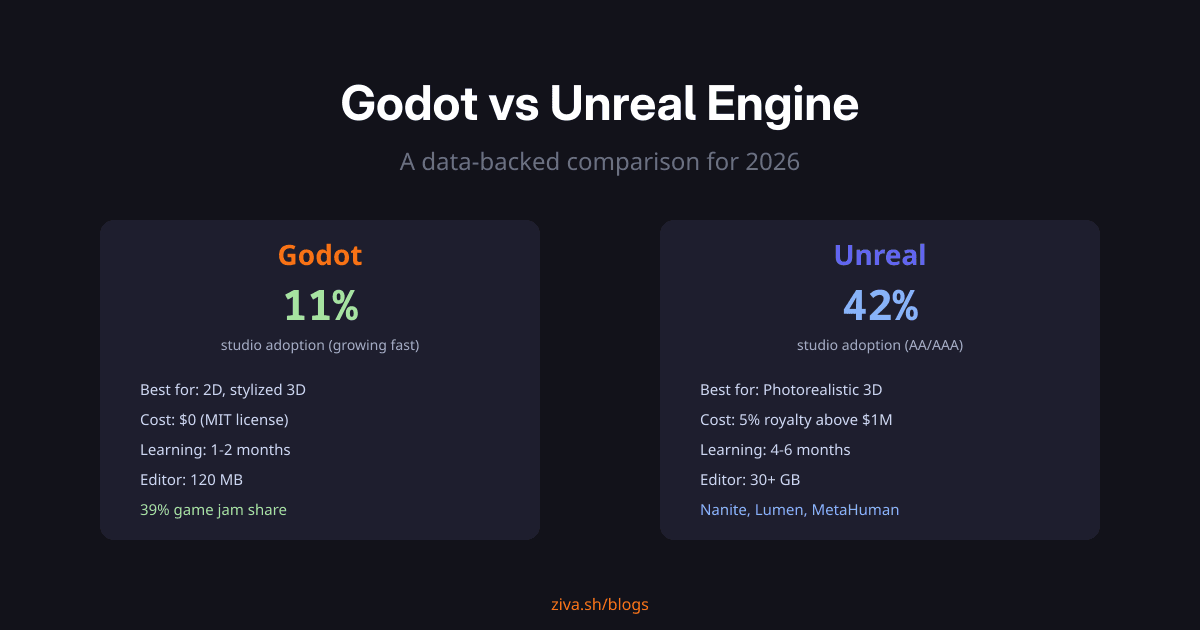
Unreal dominates AA/AAA (42% market share). Godot holds 11% among new indie studios but is growing fast (39% game jam share).
Godot wins at 2D, development speed, and cost ($0 royalties). Unreal wins at photorealistic 3D, large teams, and production pipelines.
- A game earning $10M pays $450,000 in Unreal royalties. Godot: $0.
Godot and Unreal Engine solve different problems for different developers. The GDC 2026 report makes the split clear: Unreal dominates AA and AAA studios at 42% market share, while Godot holds 11% among new indie studios and is growing fast.
If you’re choosing between them in 2026, the decision comes down to what you’re building, how big your team is, and how much you’re willing to spend.
Market share and who uses what
The GDC 2026 survey of 2,300+ game professionals breaks down engine adoption:
| Engine | Market share | Primary users |
|---|---|---|
| Unreal Engine | 42% | AA studios (59%), AAA studios (47%) |
| Unity | 30% | Established indie studios (54% of older indies) |
| Godot | 11% | Newer indie developers |
Unreal’s dominance in the AA/AAA space is partly self-reinforcing. Studios that need to hire experienced developers pick the engine those developers already know. Unreal has the largest pool of experienced 3D developers, the deepest documentation for complex systems, and the most mature production pipelines.
Godot’s 11% understates its momentum. At the GMTK Game Jam 2025 (9,724 entries), Godot held 39% share, up from 13% four years earlier. The engine has 108,527 GitHub stars and a 307K-member subreddit. The developers choosing it for jams will eventually choose it for commercial projects.
Where each engine wins
Unreal wins at:
- Photorealistic 3D: Nanite, Lumen, and World Partition are technologies Godot doesn’t have. If your game needs high-fidelity environments with dynamic lighting and massive open worlds, Unreal is the only realistic option.
- Established production pipelines: Motion capture, cinematic sequencing, and Quixel Megascans integration give Unreal a complete AAA content pipeline.
- Large team collaboration: Unreal’s multi-user editing and robust source control integration handle teams of 20+ better than Godot’s current tooling.
Godot wins at:
- 2D games: Godot’s 2D pipeline is purpose-built, not a 3D engine with 2D bolted on. For platformers, RPGs, roguelikes, and visual novels, Godot has almost no weaknesses.
- Development speed: The editor is 120MB, launches instantly, and hot-reloads scenes in real time. Unreal projects can take minutes to compile.
- Cost: Godot is MIT-licensed with zero royalties. Unreal takes 5% of gross revenue above $1M . For a game that earns $2M, that’s $50,000.
- Solo and small-team development: GDScript is Python-like and fast to iterate with. Unreal’s C++ is powerful but demanding, with long compile times that slow iteration.
The 3D gap is real but narrowing
Godot 4.6 (released January 2026) brought significant 3D improvements : Jolt Physics as the default 3D engine, rewritten Screen Space Reflections, up to 7x faster 2D draw performance, and reinstated Inverse Kinematics.
For stylized 3D games, Godot is capable. Cassette Beasts sold 1.1M copies. Cruelty Squad earned ~$19.7M. These are commercially successful 3D Godot games, but both use stylized art rather than photorealism.
For photorealistic 3D, Godot is not there. It lacks equivalent technologies to Nanite (virtualized geometry), Lumen (global illumination), and MetaHuman (realistic character creation). This gap will take years to close, if it closes at all. Godot’s development team has been clear about prioritizing stability and workflow over chasing AAA feature parity.
The cost comparison nobody does
Most engine comparisons list pricing but don’t calculate what it means for a real project.
| Scenario | Unreal cost | Godot cost |
|---|---|---|
| Game earns $500K | $0 (under $1M threshold) | $0 |
| Game earns $2M | $50,000 (5% of $1M above threshold) | $0 |
| Game earns $10M | $450,000 | $0 |
| 3-person team, 18 months | $0 engine + $450/mo for 3 VS licenses | $0 total |
For indie games that earn under $1M, the cost difference is zero. For games that break out, the 5% royalty becomes significant. Indie games generated 25% of Steam’s total revenue in 2025, and the hits that drive that revenue would pay substantial Unreal royalties.
Developer experience: a real migration story
Game producer Alex Itsios documented switching from Unreal to Godot after months of frustration building a 2D game. Setting up camera boundaries in Unreal consumed nearly a month. Translucent textures caused sprites to vanish entirely. Hand-drawn backgrounds rendered correctly in the editor but became distorted and jagged in builds.
After switching to Godot, Itsios found the 2D-specific documentation extensive, the community “very supportive and quick to offer solutions,” and collaboration easier since team members already used the engine. “I probably should have followed the advice of other developers and chosen an engine like Godot from the start.”
The lesson: Unreal is built for 3D. Using it for 2D is fighting the engine.
AI tooling favors Godot’s architecture
One factor most engine comparisons miss: how well AI coding tools work with each engine.
Godot stores everything as human-readable text (.tscn scenes, .gdscript code, .tres resources). AI tools can read and modify any file in a Godot project. Unreal stores much of its scene and asset data as binary, which AI tools cannot parse directly.
This matters more as AI-assisted development becomes standard across the industry. The 36% of game developers who use AI tools get measurably more from them in engines where the file formats cooperate.
The decision framework
Choose Unreal if:
- Your game needs photorealistic 3D graphics
- Your team has 10+ people with Unreal experience
- You’re targeting AAA or high-end AA quality
- Budget for engine royalties is planned into your business model
Choose Godot if:
- You’re building a 2D game of any complexity
- You’re building a stylized 3D game (not photorealistic)
- You’re a solo developer or small team (1-5 people)
- Development speed and iteration time matter more than graphical fidelity
- Zero licensing cost and zero royalties are important to your business model
- You want to use AI tools that understand your project structure
The wrong choice is picking Unreal for a 2D indie game or picking Godot for a photorealistic open-world title. Everything in between depends on your priorities.