Steam Next Fest 2026: What the Data Actually Says
June 2026 Next Fest runs June 15 to June 22, ending just three days before the Steam Summer Sale kicks off on June 25 . October 2026 runs October 12 to October 19.
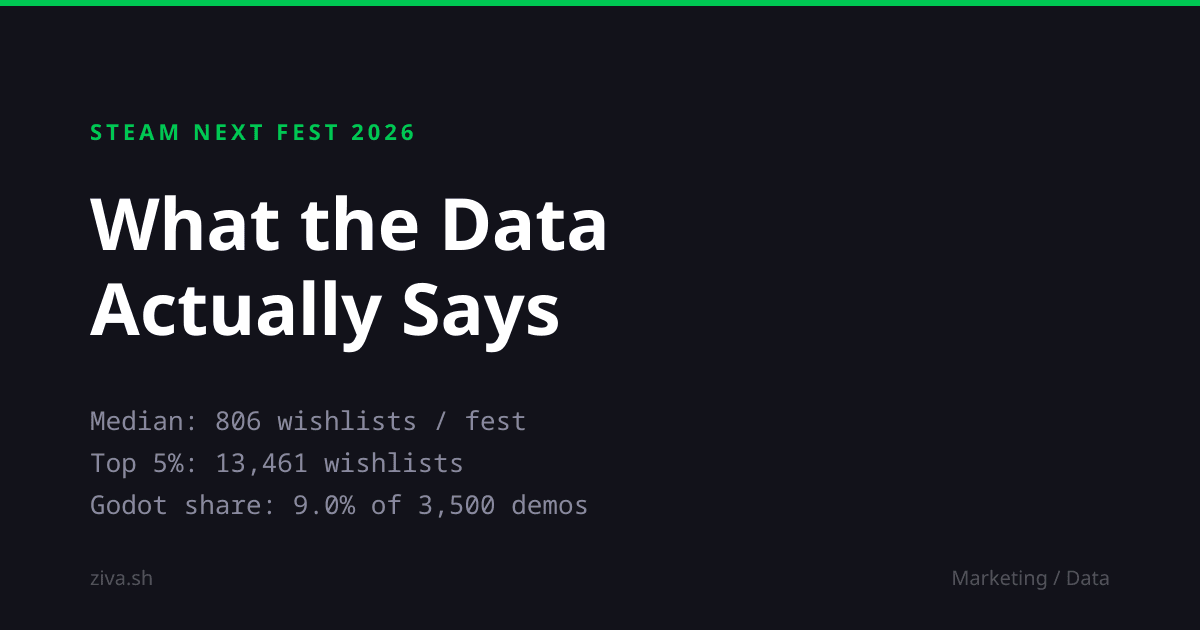
The median demo added 806 wishlists in February 2026. The 70th percentile hit 1,839, the 95th hit 13,461, and the single breakout reached 57,074, per a survey of 182 developers by How To Market A Game .
Pre-fest wishlists correlate with fest earnings at r = 0.825. If you are entering with fewer than 1,000 wishlists, the median outcome is 322 more. If you enter with 100,000, the median is 12,882 more.
Godot powered 9% of the 3,500 demos, up from roughly 6% a year earlier, per gamediscover.co’s engine scan . Unity sat at 52.2%, Unreal at 17.9%.
June 15 to June 22, 2026
Steam Next Fest is a free, week-long showcase of demos for upcoming games. For 2026, Valve has confirmed three editions :
| Edition | Dates |
|---|---|
| February | February 23 to March 2, 2026 |
| June | June 15 to June 22, 2026 |
| October | October 12 to October 19, 2026 |
All three run 10:00 AM PDT to 10:00 AM PDT. Any unreleased game with a playable demo is eligible, and each game can participate in exactly one Next Fest . Pick the one closest to launch if you want the demo to drive conversion, or the earliest one you can ship a competent build for if you need feedback.
The June edition is the most competitive slot because the Summer Sale follows it by three days. Steam users who wishlist during Next Fest get a sale-window buying prompt almost immediately.
What a realistic Next Fest outcome looks like
The clearest dataset on recent Next Fest performance is Chris Zukowski’s benchmark survey of 182 developers who participated in February 2026. The distribution is steep.
The median is roughly 800 wishlists over a week. That is not a breakout. It is not even enough to put a game on Steam’s radar for organic distribution, since games under 50 reviews stay effectively invisible in Steam’s algorithmic surfaces.
Zukowski groups outcomes into four tiers for mental modeling:
| Tier | Wishlists Earned | What It Means |
|---|---|---|
| Bronze | 0 to 999 | Marketing did not break through, or timing was wrong. |
| Silver | 1,000 to 6,999 | Respectable for most solo or two-person teams. |
| Gold | 7,000 to 9,999 | Strong execution, probably repeat participant or paid media. |
| Diamond | 10,000+ | Typically requires a viral moment or existing IP / following. |
Two thirds of respondents landed in Bronze or lower-Silver. The diamond tier is the exception, not the target.
Pre-fest wishlists explain most of the outcome
The single strongest correlation in the February 2026 data is between a game’s pre-fest wishlist count and the wishlists it earns during the event. Spearman r = 0.825. For context, most marketing correlations in indie data sit at 0.2 to 0.4.
The takeaway is uncomfortable: Steam Next Fest mostly amplifies momentum a game already has. The algorithm treats pre-fest wishlists and recent wishlist velocity as a quality signal and distributes the demo accordingly. Zukowski also reports a velocity correlation of r = 0.819 for the two weeks leading into the fest.
A cold-launched demo with no follower base has roughly a 1 in 20 chance of climbing into the 95th percentile. Picking the right fest slot matters, but picking it for a game with no pre-fest following will not bend the distribution.
Ship the demo early, not the week of
Games that launched their demos months before Next Fest earned roughly 2.5x the median wishlists of games that launched the demo during the fest itself, per the same survey . The correlation is modest (r = −0.205) but directionally consistent across three recent fests.
The mechanism is not mysterious. Early demos accumulate download counts, reviews, and wishlist velocity that Steam reads as a quality signal when the fest window opens. They also leave time for streamer coverage, TikTok clips, and Discord iteration.
Cairn from The Game Bakers is the clearest example. Their demo launched December 5, 2024, roughly 16 months before their October 2025 Next Fest slot. By the time the fest started, the demo had over 200,000 downloads and the game held 32,000 wishlists. Cairn hit #5 on Steam’s “Popular Upcoming” chart on Day 1.
Desktop Defender from Conradical Games is the counter-example that works anyway. Their demo launched two hours before Next Fest began. They entered with just 200 wishlists and earned 20,000 during the event, but the game broke out because it hit a trending genre (idle auto-battlers). That is survivorship.
The magic number is 20%
Steam tracks a “demo conversion rate” on the partner side, calculated as (players who played and wishlisted) divided by (total players). The February 2026 survey puts the distribution at:
| Metric | Conversion Rate |
|---|---|
| 30th percentile | 12% |
| Median | 16.33% |
| 70th percentile | 20% |
A rate around 20% is the informal target. Car Service Together hit 37.5% in October 2025, the highest of the games Alinea Analytics tracked. It also had the highest wishlist-to-buyer conversion at launch (3.8%) and earned $1.6M on 100,000+ copies at $18.
Co-op games routinely underperform on this specific metric because two players counted as “total players” only generate one wishlist if they were already friends who planned to buy together. High wishlist volumes with low conversion rates are common for friend-coordinated genres.
What the breakout games actually did
The outliers are instructive, but none of them were lucky in isolation. All of them entered the fest with a structural advantage.
| Game | Developer | Pre-fest wishlists | Fest-week wishlists added | Catalyst |
|---|---|---|---|---|
| Reanimal | Tarsier Studios | ~300K | ~100K+ | Little Nightmares lineage |
| YAPYAP | BAPBAP team | 200K+ | ~90K | 1.5M-view TikTok announcement |
| LORT | Solo dev | 45K (pre-demo) | ~17K | Demo launched 4 months early; steady climb on “Popular Upcoming” |
| Desktop Defender | Conradical Games | 200 | 20K | Idle auto-battler at peak genre trend |
| Cairn | The Game Bakers | 32K | Top 5 Popular Upcoming | 16-month demo runway; 200K+ demo downloads |
| Crashlands 2 | Butterscotch Shenanigans | ~50K (est.) | 15,987 | Existing audience from Crashlands 1 |
| Ship Shaper | Tomas Sala | small | 11,566 | Rapid demo launch + viral TikTok support |
Six of the seven had either an existing audience, a viral catalyst, or a long demo runway. Desktop Defender is the exception, and its breakout was powered by genre timing (idle auto-battler) more than anything Conradical Games did inside the fest.
The lesson is not “go viral.” The lesson is that Next Fest rewards preparation that happened months before the fest. A team that finishes the demo on day one of Next Fest has already decided what its outcome will look like.
Godot games hit 9% of Next Fest demos in 2026
Of the 3,500 demos in the February 2026 Next Fest, gamediscover.co’s engine scan attributed 9.0% to Godot. That is roughly 315 Godot-built demos. A year earlier the share was closer to 6%. Unity held 52.2% and Unreal 17.9%.
Godot’s share is still smaller than Unity’s, but the trajectory matters more than the absolute number. Between Buckshot Roulette’s $6.9M , Dome Keeper’s $6.1M, and Slay the Spire 2 crossing $108M in March 2026 , the notion that Godot is a hobbyist-only engine no longer holds. Ziva tracks Godot’s broader growth stats here.
For solo and micro-studio developers, Godot’s appeal at Next Fest is practical. The engine ships smaller binaries, compiles faster than Unity’s C# build pipeline, and does not require recurring revenue share. For a demo you are going to iterate on weekly based on Discord feedback, iteration speed matters more than render features nobody is going to see in a 15-minute demo.
A calendar-first checklist
If you are planning for the June 2026 or October 2026 fest, the timing is what matters most.
Six months out
- Get the Coming Soon page live and start running whatever small-scale organic marketing you can. Steam’s algorithm reads velocity over absolute counts, so a steady trickle is better than a one-week spike.
- Decide what the demo will be. The How To Market A Game data suggests 15 to 30 minutes of playable content is the sweet spot.
Three months out
- Ship the demo. A demo live for 90 days before the fest is far enough ahead to accumulate review count, demo velocity, and streamer mentions before the fest window opens.
- Use the two weeks before the fest for a trailer push. Pre-fest velocity correlates at r = 0.819 with fest earnings.
During the fest
- Do not launch the demo on day one unless you have no other option. Daily updates during the fest cause more problems than they solve; patch only if the demo is broken.
- Run a stream schedule with creators you have pre-booked. Cold outreach during the fest is too late; creators are drowning in demo pitches that week.
One week after
- The fest wishlist bump decays over roughly 30 days. Plan the follow-up devlog or trailer for 7 to 10 days after the fest ends to extend the velocity curve.
Tools like Ziva can compress the “ship a playable demo” phase for Godot teams specifically, because the agent can wire up scenes, testing, and build pipelines without the usual boilerplate. The demo still has to be good. Nothing in the Next Fest data suggests you can fake that with tooling.
The surprise hit is a myth, but Next Fest is still worth doing
The frustrating truth in the 2026 data is that Steam Next Fest is not a discovery engine for games with no following. It is an amplifier for games that already have one. A solo developer entering with zero wishlists should expect roughly 300 wishlists out the other side, and should plan accordingly.
That does not make the fest a waste of time. 300 wishlists of real interest is still 300 wishlists, the demo gets a permanent home on the store page, and Steam’s algorithm reads the fest participation as a quality signal for the Coming Soon surfaces afterward. What it is not is a substitute for doing marketing the other 51 weeks of the year.
If you are shipping a Godot game in 2026 and are weighing whether to cram for June or defer to October, the right question is how many months of demo runway you can get before the fest date. If the answer is “three or more,” go. If the answer is “launch the demo in Next Fest itself,” wait for October.
For deeper dives on the related decisions, see Ziva’s breakdown of solo game development in 2026 and the complete guide to publishing a game on Steam.