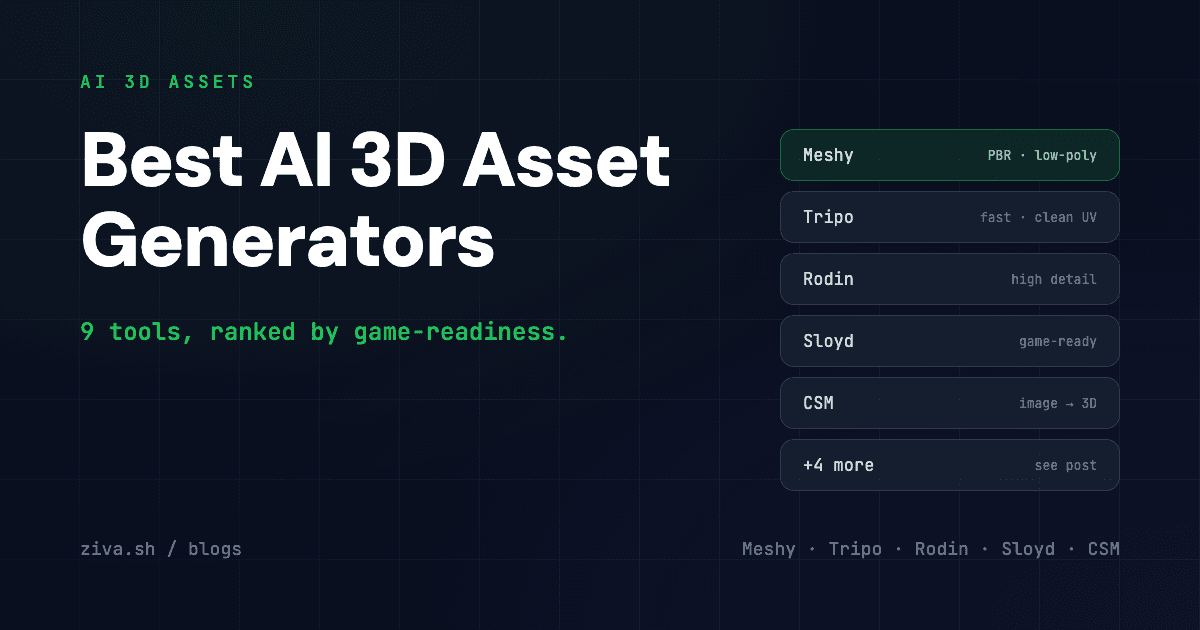
Best AI 3D Asset Generators in 2026: 9 Tools Compared for Game Devs
Text-to-3D and image-to-3D went from “fun demo” to “shippable for indie pipelines” between 2024 and 2026. Topology cleaner, UVs more often usable, PBR maps actually baked. But the gap between tools is wider than the marketing suggests: a generator that produces a beautiful render preview may still drop a 200k-triangle blob with N-gons and overlapping UVs into your project. We tested nine generators against the same six prompts (one hard-surface prop, one stylized character bust, one low-poly building, one organic creature, one mechanical asset, one architectural element) and judged them on game-readiness, not Instagram-readiness. Here are the picks for 2026.
What “game-ready” actually means
Most generator marketing pages skip past the things that matter once an asset hits a Godot, Unity, or Unreal project:
- Quad-dominant topology (or at least clean tris) — n-gons explode in engine shaders
- Single UV island per material, no overlap — required for lightmaps and decals
- Predictable triangle budget — a 5k-tri prop and a 200k-tri prop both look the same in a turntable preview
- PBR map separation — basecolor / metallic / roughness / normal as separate channels, not a single baked diffuse
- Rigging-friendly axis and pivot — origin at base, +Z up (or +Y, but consistently)
We weighted the ranking heavily on these. Render quality alone is a misleading signal.
The 9 contenders at a glance
| Tool | Type | Pricing | Best for |
|---|---|---|---|
| Meshy | Text + image to 3D | Free tier, $20/mo Pro | Indie devs, fastest iteration |
| Tripo | Text + image to 3D | Free tier, $20/mo Pro | Cheapest paid plan, high volume |
| Rodin | Text + image to 3D | Free tier, $15/mo Pro | Highest fidelity organic meshes |
| Sloyd | Parametric generators | Free tier, $15/mo Pro | Low-poly, game-ready out of box |
| CSM | Image-to-3D | Free tier, $20/mo Pro | Single-image reconstruction |
| Hyper3D | Text + image to 3D | Free tier, credit-based | Quad retopology by default |
| Kaedim | Concept-art to 3D | $150+/mo | Studios needing reviewed output |
| Luma Genie | Text-to-3D | Free tier, $30/mo Pro | Fast turntable previews |
| Stable Fast 3D | Image-to-3D (OSS) | Free (self-host) | Privacy, batch pipelines |
Best all-rounder: Meshy
Meshy is the default recommendation for solo developers in 2026. The Meshy 5 model (released January 2026) closed most of the topology gap that made earlier versions a chore: the auto-remesh step now produces quad-dominant output with mostly clean UV unwraps, and PBR maps separate cleanly. Text-to-3D and image-to-3D in the same dashboard, plus a texture-only mode for re-skinning meshes you already have.
The free tier (200 credits / month, ~50 generations) covers casual use. The $20/mo Pro tier unlocks 4K textures, higher poly budgets, and the API. If you only try one generator from this list, try Meshy first.
Best for: indie developers iterating on a lot of props.
Best price-per-asset: Tripo
Tripo (Tripo3D / VAST AI) ships at roughly Meshy quality and a slightly lower monthly price. The asset library and prompt-history UI is cleaner, and the v3 model handles hard-surface mechanical assets noticeably better than the organic-bias models elsewhere on this list. If your project is mostly props and machinery rather than creatures, Tripo is the lower-friction pick.
The trade is a slightly higher rate of overlapping UVs on highly concave shapes — flag the affected meshes and re-run with auto_unwrap=true in the API.
Best for: high-volume prop generation where per-asset cost matters.
Best fidelity: Rodin
Rodin by Deemos beats Meshy and Tripo on organic and stylized character output. The detail headers — pore-level skin detail on busts, individual fiber strands on cloth — are visibly ahead of the field. The cost is generation time (~3-5 minutes per asset vs. 30-60 seconds elsewhere) and a slightly noisier topology for hard-surface props.
Rodin’s $15/mo Pro plan is also the cheapest paid tier of any tool here, which surprises buyers used to Kaedim’s pricing.
Best for: character and creature work where silhouette and detail matter.
Best game-ready out of the box: Sloyd
Sloyd is structurally different from the others on this list. Rather than diffusing a mesh from a prompt, Sloyd uses parametric generators (weapons, furniture, buildings, vehicles, vegetation) with sliders that adjust topology under the hood. Output is consistently low-poly (1k-15k triangles), correctly UV-mapped, and rigging-ready. The trade is creative range: if it isn’t in their generator catalog, you can’t make it. But what is in the catalog ships into a Godot or Unity scene without cleanup.
Sloyd integrates directly with Godot via the asset library, and the marketplace addon lets you preview meshes before downloading.
Best for: developers who need clean, predictable, low-poly assets and don’t need creative freedom.
Best image-to-3D: CSM
CSM (Common Sense Machines) is the strongest single-image reconstruction model in 2026. Feed it one reference photo or concept art and it produces a more accurate 3D interpretation than image-to-3D modes on Meshy or Tripo. CSM also handles “back-side” inference better — the hidden faces of an asset look less like average-of-training-data soup and more like the photographed object.
Sketch-to-3D mode is interesting in concept but still rough; treat it as preview-quality. Text-to-3D mode exists but is weaker than Meshy or Tripo.
Best for: studios reconstructing existing IP or concept-art workflows.
Best topology: Hyper3D
Hyper3D (Hyper) makes a specific bet: quad retopology is part of the generation pipeline, not a post-step. The output is consistently quad-dominant — usually the cleanest topology in the field — which makes Hyper3D the pick when you plan to hand-rig the mesh or subdivide for sculpting passes. Texture quality lags Meshy and Rodin slightly, but you can re-texture in either of those tools afterward.
Pricing is credit-based; expect ~$0.20-$0.40 per high-quality generation.
Best for: technical artists who care about subdivision-safe topology.
Best for studios with reviewers: Kaedim
Kaedim sits in a different category: not a self-serve generator but a human-in-the-loop service where AI produces a draft and reviewers ship a cleaned mesh. Quality is the highest on this list — bake-ready PBR, clean UVs, predictable topology — but the price ($150-$600/mo) and turnaround (~24 hours) only makes sense for funded studios.
If a solo developer is reading this, Kaedim is not your tool. If a studio is, it is the only one here you can put on a production deadline.
Best for: studios needing AAA-adjacent quality without an outsourced art house.
Best for fast preview: Luma Genie
Luma Genie generates text-to-3D in 10-15 seconds — by far the fastest on this list. The output is rough (~30k triangles, often noisy normals) and not directly game-ready, but Luma is ideal as a brainstorming layer: prompt 20 variations of a sword, pick the silhouette you like, then regenerate that one in Meshy or Rodin for the production asset.
Best for: ideation and blockout, not final art.
Best open source: Stable Fast 3D
Stable Fast 3D is Stability AI’s open-source image-to-3D model, runnable on a single consumer GPU (~6GB VRAM) in under a second per asset. Quality is below the closed-source tools but the privacy and batch-pipeline story is unbeatable: you keep your concept art on-prem, never send IP to a third-party API, and can run thousands of generations as part of a procedural pipeline.
The community is also maintaining LoRA fine-tunes for specific styles (low-poly, voxel, isometric) which the closed-source generators can’t match.
Best for: privacy-sensitive workflows, batch processing, hobbyists with a GPU.
Quick decision guide
| If you want… | Pick |
|---|---|
| One tool to start with | Meshy |
| Lowest cost per asset at volume | Tripo |
| Character / creature work | Rodin |
| Clean low-poly assets, no cleanup | Sloyd |
| 3D from one reference photo or concept | CSM |
| Quad topology for rigging or sculpting | Hyper3D |
| Reviewed AAA-adjacent quality | Kaedim |
| Fast ideation / blockout | Luma Genie |
| Privacy, batch, or hobbyist self-host | Stable Fast 3D |
Using these in Godot
Most of these tools export .glb or .gltf, which Godot 4 imports natively. A few notes from the testing pipeline:
- Drop the
.glbintores://assets/generated/and let Godot’s import dock do the conversion. The default “Scene” import settings work for Meshy, Tripo, Rodin, and Hyper3D output. Sloyd output sometimes needs “Reset” on the mesh import to clear stale lightmap UV2 channels. - For game-ready triangle budgets, use Godot’s built-in GLTF compression (Draco) on the import step. Meshy and Tripo respect this; Rodin’s bake quality can drop slightly under aggressive compression.
- Generated assets ship with a single material slot 90% of the time. If your shader expects separate material indices (e.g. emissive panels on a robot), split the mesh in Blender before import.
If you’re using an AI tool like Ziva in the editor, you can drop a generated .glb into the chat and ask the agent to set it up in the scene tree — Ziva handles the import settings, instances the mesh, and applies a starting material. See the Ziva AI tools for Godot guide for the broader plugin landscape, or how to use AI with Godot for the end-to-end workflow.
What we’d skip
Three categories of tool came up in research but didn’t make this list:
- “3D from video” generators (NeRF / Gaussian-splat pipelines like the original Luma Capture) — these are great for environment capture but produce point clouds or split meshes that need too much cleanup for prop work.
- Re-skinned Meshy clones. Several 2025-launched products are thin UIs over the Meshy or Tripo APIs. Use the upstream tools directly.
- Closed-platform generators with no export. A handful of tools generate “3D” that only renders inside their own viewer. Skip these for game work.
The space is still moving fast. We’ll refresh this list in early 2027.