Godot Mobile in 2026: Ready for Premium, Not Live Service
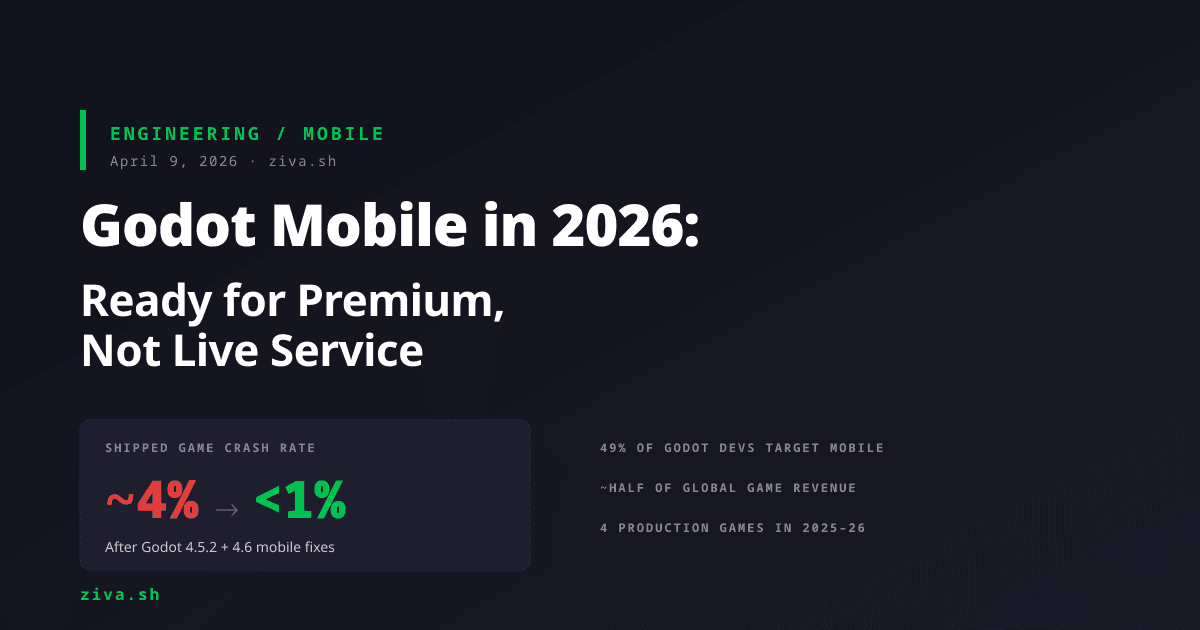
Crash rates on shipped Godot mobile games dropped from ~4% to under 1% after the fixes in Godot 4.5.2 and 4.6, per data from Rift Riff and Kamaeru published by the Godot Foundation . That moves Godot mobile apps inside the 1.09% “bad behavior” threshold Google Play treats as acceptable .
49% of Godot developers target mobile per the Foundation’s own community polling cited in the April 2026 update. Mobile games represent roughly half of global game revenue , so this is not a niche platform to write off.
Premium and pay-once mobile games are the ready-today use case. Freemium with heavy IAP is still painful because the official iOS IAP plugin has been unmaintained since 2022 . The Foundation now maintains Godot Google Play Billing and Godot StoreKit 2 as supported alternatives.
Godot 4.6 closed the biggest dev-loop gap by adding Android device mirroring inside the editor and instrumented tests, plus native debug symbols for Android crash analysis introduced in 4.5 . Xcode is still required on macOS for iOS builds.
Mobile matters more than any other platform
Mobile is where game revenue lives. Industry forecasts for 2026 put global game revenue at roughly $205B with mobile capturing over half of it, more than PC and console combined. For a solo developer choosing an engine in 2026, “can my engine ship a mobile build that the App Store actually approves and that Google Play does not flag for crash rate” is the question that decides whether the engine can pay rent.
Godot’s own community poll, cited in the April 2026 mobile update from the Foundation , reports that 49% of Godot developers target mobile platforms. That number is why the Foundation put real engineering effort into mobile stability over the last two releases, and why the results are worth looking at with specifics.
~4% to under 1%, with named games
The most important data point in the whole mobile-on-Godot story comes from two shipped games that handed their crash logs to the Foundation. Rift Riff from Adriaan de Jongh , released on iOS and Android in October 2025, and Kamaeru: A Frog Refuge from Humble Reeds , released in December 2025, both launched with user-perceived crash rates of roughly 4% on Google Play. That is nearly four times the 1.09% “bad behavior” threshold that Android Vitals treats as the point where store visibility starts to suffer .
Between the two games, Foundation contractors had enough crash logs to identify the patterns: broken Mali and Adreno GPU drivers, Vulkan API misuse, edge cases on the long tail of 12,000+ distinct Android device models in active use. The fixes landed in Godot 4.5.2 and 4.6, and both games dropped to under 1%.
This is the difference between a game that has store visibility and one the algorithm buries. Kamaeru’s and Rift Riff’s data are the first production evidence that Godot’s mobile renderer is operating inside the tolerance band that Apple and Google enforce on reviews and ranking.
The caveat is that neither developer was shipping a blind build. Both handed their crash logs and source projects to the Foundation. If you ship a Godot mobile game today and hit similar Adreno-specific issues, you should expect to file GitHub issues and wait. The 4% to 1% improvement is the ceiling after triage, not the floor of a cold install.
The commercial track record has numbers attached
Four shipped games across 2023 through 2025 make the 2026 answer much less hypothetical than it was a year ago.
| Game | Developer | Mobile release | Platforms | Model | Notes |
|---|---|---|---|---|---|
| Brotato | Blobfish + Erabit Studios (mobile port) | March 2023 | iOS, Android | Free + paid | 10M+ copies sold across platforms by 2025 |
| Spin Hero | Goblinz Studio | 2025 | iOS, Android | Premium | Roguelike deckbuilder port of the 2024 PC release |
| Rift Riff | Adriaan de Jongh | October 2025 | iOS, Android | Try-free then $, no ads | Godot 4.5.1 at launch; Foundation crash-fix case study |
| Kamaeru: A Frog Refuge | Humble Reeds | December 2025 | iOS, Android | Premium | Second case study for Foundation mobile fixes |
Brotato is the most important entry on this list because it is the commercial proof case. The desktop original shipped 10M+ copies by 2025 and the mobile port generated a meaningful fraction of that, confirming that a Godot game can survive both app store review processes and earn at scale. That evidence did not exist three years ago.
The premium model dominates this list on purpose. Every shipped Godot mobile success in 2025 or 2026 either charges up front or offers a pay-once unlock. None of these games are live-service, ad-heavy, or built around dozens of IAP SKUs, and the reason is not coincidence — it is that Godot’s monetization tooling still favors the simpler revenue models.
The concrete changes in the last two releases
The April 2026 mobile update is a summary, not a changelog. Below is the specific list of items Godot developers can use today.
Android, landed:
- Native debug symbols generation introduced in Godot 4.5 , with debug symbols for crash-log uploading to Google Play Console available stable in 4.5.2. Before this, Godot crash stacks on Android were effectively unreadable.
- Device mirroring in the editor in Godot 4.6: connect an Android phone via USB and the Godot editor streams its screen back, so a developer can iterate on touch UI without constantly exporting APKs.
- Instrumented test support in Godot 4.6, so you can run unit and integration tests against an actual Android device or the Firebase Test Lab device fleet.
- Vulkan API corrections and workarounds for Mali and Adreno GPU driver bugs in 4.5.2 and 4.6.
iOS, landed:
- Auto-enabled export settings in Godot 4.6 to reduce the risk of shipping an IPA that technically installs on certain iPads but cannot actually run.
- Godot StoreKit 2 plugin under Foundation maintenance, replacing the 2022-era community iOS IAP plugin that sat unmaintained for two years.
- Starting April 2026, App Store submissions must be built with the iOS 26 SDK , which means Xcode 16+ on macOS. Godot’s iOS export wraps the Xcode project, so this is an Xcode requirement, not a Godot requirement.
Still missing:
- A first-party on-screen controls node. Godot has had TouchScreenButton since 3.x, but as of early 2026 there is still no high-performance native virtual-joystick or on-screen-gamepad system , and teams routinely pull in community addons.
- Maintained Godot SDKs from the large mobile analytics vendors. GameAnalytics, Amplitude, Adjust, and AppsFlyer do not ship Godot bindings , so teams either hand-roll HTTP wrappers or skip them.
The plugin ecosystem is the real gap
Mobile is where Unity’s accumulated ten-year lead in tooling shows most clearly. Pretending otherwise does not help anyone picking an engine.
The biggest delta is the plugin ecosystem. Unity’s official AdMob, Facebook, Firebase, IronSource, and AppLovin plugins are maintained directly by the vendors themselves. Godot’s equivalents are a mix of Foundation-maintained (Google Play Billing, Google Play Games Services, StoreKit 2), community-maintained (AdMob forks, IAP wrappers), and outright absent (most analytics SDKs). One 2024 teardown documents a developer giving up after failing to export with AppLovin MAX, noting that GameAnalytics had not been updated in 2+ years and that Amplitude, Adjust, and AppsFlyer had no Godot support at all. The ecosystem has improved since that post, but the gap is real.
The second delta is the lifecycle hook. Godot controls the iOS app lifecycle entirely, so there is no direct AppDelegate access for the third-party SDKs that expect to hook initialization on didFinishLaunchingWithOptions. Developers have worked around this with custom plugins, but it takes iOS platform expertise that most Godot-only developers do not have.
Pick a revenue model before you pick an engine
The recommendation depends entirely on how the game makes money.
Premium one-time purchase: Godot is ready. Rift Riff, Kamaeru, and Spin Hero all use some flavor of “try free or pay once, no ads.” StoreKit 2 and Google Play Billing both work, unlock flows are straightforward, and the April 2026 crash fixes bring the tech stack inside store-ranking tolerance.
Freemium with ads: Works, with third-party plugins. The Poing Studios godot-admob-plugin , which in 2026 consolidated the older separate Android and iOS repos, is the default pick. Expect to version-pin your Godot release to a specific plugin tag and budget a day of integration work per release. No mediation platform (AppLovin MAX, IronSource, Unity LevelPlay) ships a first-party Godot SDK in 2026.
IAP-heavy games: The monetization tooling works, but expect friction. The December 2024 forum thread on “Frustrating state of Godot mobile IAPs” has a developer, mrusso, reporting that he had to downgrade to Godot 4.1.3 to get iOS IAPs functional. The Foundation’s StoreKit 2 plugin addresses the iOS side of that complaint, but the underlying pattern — needing to track plugin compatibility separately from engine version — is still there.
Live-service with mobile-first analytics: Unity is still the better pick. If the product depends on 20+ live events per year, cohort analysis, funnel tracking through a paid analytics SDK, and sub-second cold-start times tuned for specific Android chipsets, Unity’s tooling and first-party vendor support will save weeks that Godot cannot.
Touch is still the hardest part
Touch input is where mobile ports of desktop games go to die. Godot’s InputEventScreenTouch and InputMap work well, but as the Godot proposals tracker notes , there is no built-in high-performance virtual-gamepad solution, and teams typically reach for a community addon like GodotTouchInputManager .
Two practical rules from developers who have shipped:
- Use gestures for directional actions, buttons for discrete ones. Swipe to dodge, drag to aim, tap to confirm. Complex key combinations (think fighting-game quarter-circles) do not translate. The Owls Department writeup of their 2D platformer with quizzes , written against Godot 3.2.2, complained specifically about the absence of native kinetic scrolling and had to implement their own. That specific gap has closed in 4.x but the principle stands: do not assume desktop-style UI ports.
- Design for the 5.5-inch phone and the 12.9-inch iPad in the same layout. Control layouts that feel right on a small phone often feel cramped on a tablet, and vice versa. Godot’s anchor system handles this cleanly if you use relative positioning from the start and ignore it if you use absolute coordinates.
What the 2026 workflow looks like
A minimal, production-ready Godot mobile dev setup in 2026:
- Godot 4.6 stable, with the Android Studio SDK installed and device mirroring enabled.
- Xcode 16 or later on a macOS machine for iOS builds. The iOS 26 SDK requirement is enforced at App Store submission, not at build time, so older Xcode will produce IPAs that Apple rejects at upload.
- Perfetto for Android performance traces and Instruments for iOS. Both are free, both have better Godot-compatible workflows than Unity’s built-in profiler on mobile.
- Google Firebase Test Lab for automated device-coverage testing across the Android long tail. The Foundation cited the free-tier limits as the single biggest constraint on their own mobile QA work, so budget for paid tier if you are shipping commercially.
- Godot Google Play Billing, Godot Play Games Services, Godot StoreKit 2 for monetization, all Foundation-maintained.
AI pair programming earns its keep on mobile Godot in a few specific places: touch-input refactors, InputMap-to-on-screen-control translation, shader compatibility checks against the Mali and Adreno driver bugs, and build-config sweeps across Android ABI variants. These are the rote, high-volume tasks that drain days during the final testing stretch before a mobile launch. Ziva handles that kind of work inside the Godot editor itself, which is where most of the friction happens.
Four quick recommendations
| Your situation | Pick | Why |
|---|---|---|
| Solo dev shipping a premium iOS + Android title | Godot | Tooling and crash-rate evidence both clear the bar; MIT licensing over recurring fees wins at this scale. |
| Studio porting an existing desktop Godot game to mobile | Godot | Every shipped game above followed this path. Budget 2–3 weeks for touch-input refactoring and store integration. |
| Studio building a live-service F2P game with heavy IAP + analytics | Unity | The analytics-SDK gap alone will cost more engineering time than Unity’s fees. Revisit Godot in 12 months. |
| Studio already on Unity with no specific reason to migrate | Unity | No 2026 technical reason to rip out working Unity integrations; the runtime-fee CEO resigned , pricing walked back. |
Godot earned production status on mobile in 2026 the slow way: named games, real crash logs, specific engineering fixes shipped to stable. That is a different kind of proof than the marketing arguments around any engine, and for the subset of developers this article is aimed at, it is the only kind of proof that matters.
Ziva’s Godot 3D capabilities piece and Godot growth stats cover the adjacent engine questions. For the Godot vs Unity mobile decision specifically, Ziva’s full comparison has more.