State of Interactive Safety Training Vendors, 2026
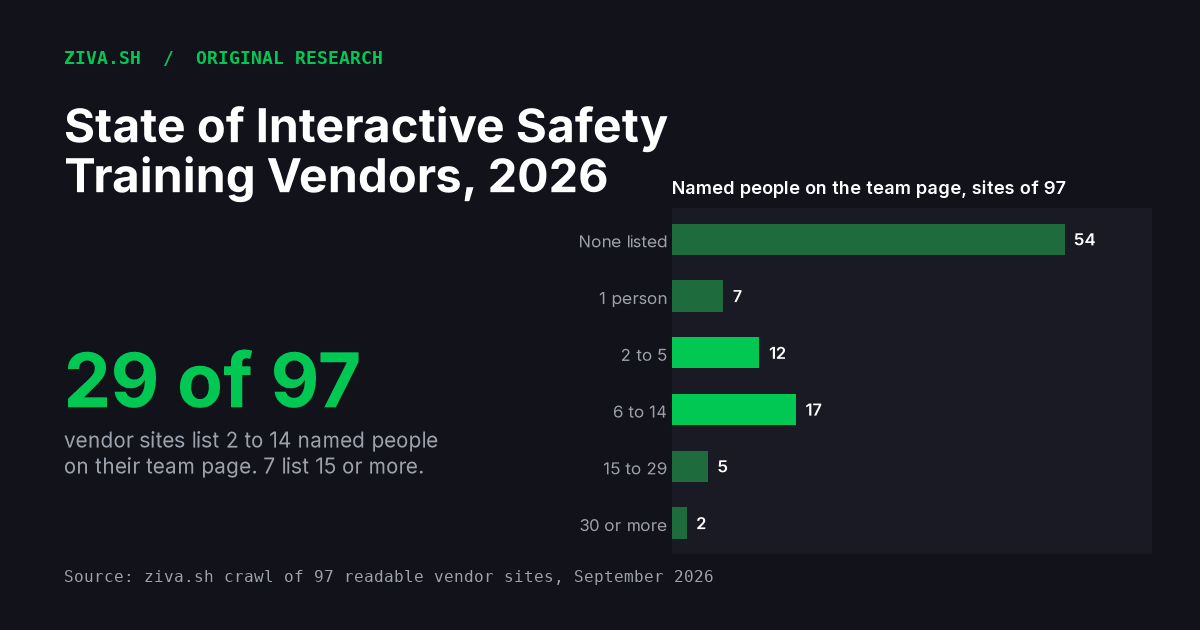
Interactive safety training vendors in 2026 describe themselves with the same handful of words, and the ones that show a team mostly show a small one. We read the public pages of 101 vendor sites in September 2026, 97 of which were readable, and counted what their team pages list and what their headlines say. 29 of the 97 sites list 2 to 14 named people on a team or about page, and only 7 list 15 or more. 44 of 97 put “immersive” in a headline. 2 put “site-specific” there, and none put “xAPI”. The lead time buyers plan around, which Ludus Global puts at 6 to 10 weeks per custom scenario , shows up in headline copy as “weeks” on exactly one site. The method and the limits of the count are at the end.
Most vendors that show a team show a small one. 43 of 97 sites name anyone on a team or about page. 29 of those list 2 to 14 people, 7 list 15 or more, and 54 sites list nobody.
The pitch vocabulary is shared. VR appears in the headline copy of 46 sites, immersive on 44, custom on 35, compliance on 35, simulation on 28.
The delivery vocabulary is nearly empty. Site-specific appears on 2 sites, no headset on 1, weeks on 1, refresher on 1, xAPI on 0.
Buyers should ask for what the headlines leave out. Who builds the 3D, whether the scene is your site or a library, the delivery format, the weeks per scenario, and whether you get editable source.
Who sells interactive safety training in 2026
The 101 domains are a list we compiled by hand, not a registry. It is a list a safety buyer could shortlist for interactive training, not a list of safety-only specialists. The domains span three kinds of company: 72 custom immersive, simulation and custom eLearning studios; 15 safety and compliance video and animation producers; and 14 safety content libraries and LMS vendors that run in-house content studios. 97 of the 101 were readable: 92 answered an HTTP client that sent a browser user agent, and 5 of the 9 that failed loaded when retried in a real browser. 3 still returned HTTP 403 in the browser and 1 domain did not resolve, so every count below is out of 97.
Most vendors that show a team show a small one
| Named people on the team page | Sites (of 97) |
|---|---|
| None listed | 54 |
| 1 | 7 |
| 2 to 5 | 12 |
| 6 to 14 | 17 |
| 15 to 29 | 5 |
| 30 or more | 2 |
43 of 97 sites list at least one named person with a job title on a team, about, people or leadership page. Of those 43, 29 list between 2 and 14 people and 7 list 15 or more. A team page is not a headcount. It is what the company chose to show, and 54 sites show nobody, so read the count as a floor, not a company size.
The 361 titles on those 43 pages describe studios, not agencies. A title can match more than one row.
| Words in the job title | Titles (of 361) |
|---|---|
| Sales, business development, partnership, partnerships, commercial, marketing, account, client, growth or revenue | 65 |
| CEO, chief executive, founder, co-founder, owner, managing director or president | 62 |
| CTO, technical, technology, engineering, developer, engineer or architect | 51 |
| Creative, production, producer, studio, delivery, programme, program manager, project manager or project lead | 29 |
| Learning, instructional, LXD, curriculum or education | 20 |
| Artist, 3D, animator, art director or environment | 9 |
| Innovation, strategy or strategist | 3 |
Three examples, all visible on the pages themselves. ForgeFX , a custom training simulation developer, lists four 3D artist titles and six developer titles on its about page. VirtualSpeech , a soft skills training platform with VR, lists four Unity developer titles. Filament Games , an educational game developer, lists five Game Engineer titles. All three pages were read on September 18, 2026. Those are the roles of a team that ships inside a game engine: the people who build games are the people who build interactive training scenarios.
The words vendors lead with
| Term in headline copy | Sites (of 97) |
|---|---|
| VR | 46 |
| immersive | 44 |
| custom | 35 |
| compliance | 35 |
| simulation | 28 |
| cost | 25 |
| engagement | 21 |
| real-world or real world | 20 |
| measurable | 17 |
| tailored | 17 |
| faster | 17 |
| LMS | 16 |
| modern, modernise, modernize, outdated or legacy | 16 |
| ROI | 14 |
| retention | 14 |
| OSHA | 13 |
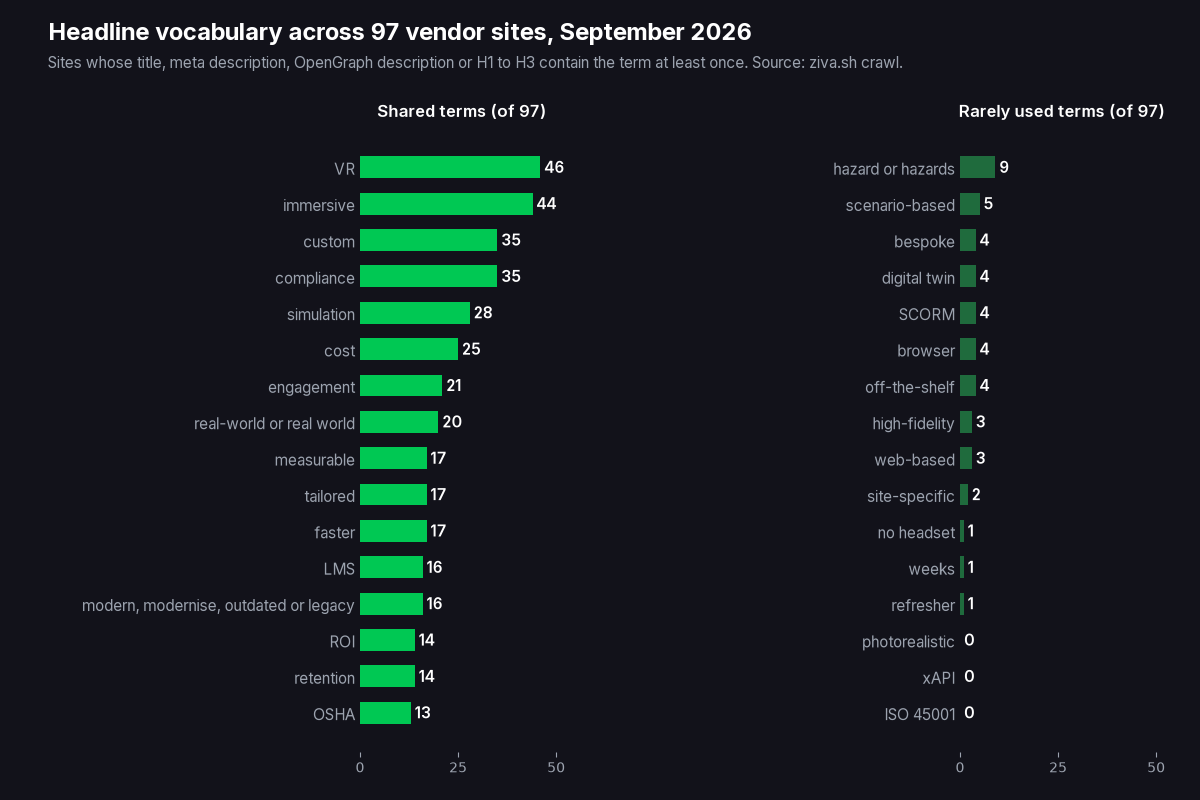
“Immersive” is on nearly half of the sites and “simulation” on more than a quarter. The commercial words (cost 25, measurable 17, faster 17, ROI 14) show vendors already selling against a budget line. “Compliance” on 35 sites and “OSHA” on 13 tie the pitch to regulation. Plain “modern” accounts for 11 of the 16 sites in the modernisation row; “legacy” and “outdated” are on 3 each. What is mostly missing is a word that tells a buyer what they get: how long it takes, what format it ships in, and whether it shows their own site.
The words almost nobody uses
| Term in headline copy | Sites (of 97) |
|---|---|
| hazard or hazards | 9 |
| scenario-based | 5 |
| bespoke | 4 |
| digital twin | 4 |
| SCORM | 4 |
| browser | 4 |
| off-the-shelf | 4 |
| high-fidelity or high fidelity | 3 |
| web-based | 3 |
| site-specific | 2 |
| no headset, without a headset or without headsets | 1 |
| weeks | 1 |
| refresher | 1 |
| photorealistic | 0 |
| xAPI | 0 |
| ISO 45001 | 0 |
The delivery vocabulary is close to empty. “Site-specific” is on 2 sites. “SCORM” and “browser” are on 4 each and “xAPI” on none. “Weeks” is on one site. “Refresher” is on one, even though HAZWOPER requires eight hours of refresher training every year under 29 CFR 1910.120(e)(8), so the training repeats every year. “Digital twin” is on 4 sites and “high-fidelity” on 3. Unity says it uses its real-time 3D technology to create digital twins , so that work happens in a game engine too. A vendor that puts a delivery format, a timeline and the words “your facility” in its headline is competing with almost nobody in this sample.
What this means for buyers
- Ask who builds the 3D. Nobody is named on 54 of 97 sites, and 3D and art titles are 9 of the 361 we read. Ask which named person will model your site.
- Ask whether the scenario is site-specific or from a library. Only 2 sites lead with “site-specific” and 4 lead with “off-the-shelf”. Both are legitimate, but the price and the timeline differ: Ludus Global quotes 1 to 2 weeks to deploy a library and 6 to 10 weeks per custom scenario .
- Ask for the delivery format in writing: headset or browser, SCORM or xAPI, and which LMS. 4 sites put SCORM in a headline and none put xAPI.
- Ask for weeks per scenario and the share of hours that goes to 3D assets. Frame Sixty puts 3D asset production at 50 to 70 percent of development hours on an immersive build , which is where a site-specific build spends its budget.
- Ask whether you get editable source after handoff. Annual refreshers mean the scenario has to change when the procedure changes, which is why Ziva’s safety training use case is built around an editable handoff and specialist approval of the procedure.
The published price and timeline anchors are collected in How Much Does Custom VR Safety Training Cost in 2026.
Methodology
- Sample: 101 vendor domains compiled by hand in September 2026 from public listings and search, spanning immersive studios, custom eLearning agencies, safety video producers and content-library vendors.
- Crawl: an HTTP client sending a Chrome user agent and running no JavaScript loaded each site’s home page and up to six internal pages whose path contained about, team, people, our-team, leadership, who-we-are, meet, services, solutions, industries, sectors, expertise, contact, work, case-stud, portfolio, projects or clients. The 9 sites that failed were retried in a real Chrome browser; 5 loaded and 4 did not. A site that still returned an HTTP error or a bot challenge was counted as unreadable.
- Headline copy: for each page, the title tag, the meta description, the OpenGraph description and the H1 to H3 headings. Body text was not read.
- Term counts: a term counts once per domain when it matches on a word boundary anywhere in that domain’s headline copy. Rows with several alternatives are the exact patterns measured: “modern, modernise, modernize, outdated or legacy”; “hazard or hazards”; “real-world or real world”; “high-fidelity or high fidelity”; “no headset, without a headset or without headsets”. The rows of the job title table are likewise the exact word-boundary patterns measured.
- Listed people: a line that looks like a personal name followed within two lines by a job title, on a page whose path contains team, people, leadership, who-we-are, meet, about, staff, our-story or company and does not contain blog, resources, solutions, expertise, news, insights or case-stud. Names and titles found on other pages, mostly customer quotes on solutions pages and bylines on blog posts, were excluded. The extractor is a heuristic.
- Counts are by domain. No names, email addresses or other personal data appear in this report, and none were used beyond counting.
Limitations
- Headline copy is not the whole site. A vendor can say SCORM on a product page and score zero here.
- A team page lists whoever the company chose to list. 54 sites list nobody, which says nothing about their size.
- 92 of the 97 sites were read without JavaScript. A team page that renders its people with JavaScript counts here as listing nobody.
- The name-and-title extractor is a heuristic. It can miss a person whose title sits on a separate card, and it can count a quoted customer if the quote sits on an about page.
- 77 of the 97 readable sites showed at least one email address on the pages we read and 20 showed none. That is not the same as having no email.
- The sample is our own compilation and is weighted to English-language sites.
- Not every vendor here is a safety specialist. 54 of the 97 put “safety” in headline copy. The other 43 do not, and 39 of those are immersive, simulation and custom eLearning studios.
- This is one snapshot; the four unreadable sites may be readable tomorrow.
- Self-description is not capability. A site that never says “site-specific” may build it every week.
Related reading
- How Much Does Custom VR Safety Training Cost in 2026: every published cost anchor with its date and source
- AI Game Engine: Why Ziva Is Built Inside Your Engine: why serious games are made inside game engines, and why Ziva is built inside the engine
- What is a game engine? Why games are built in one: what an engine supplies, from physics and graphics to the editor and export
- What is Ziva? Build games faster with AI: the product in one page
If you sell or buy interactive safety training, Ziva’s safety training use case builds reviewable scenarios from approved procedures, with measurable assessments and an editable handoff. Enterprise pricing is custom to the organization, engine and use case.