How Much Does Custom VR Safety Training Cost in 2026
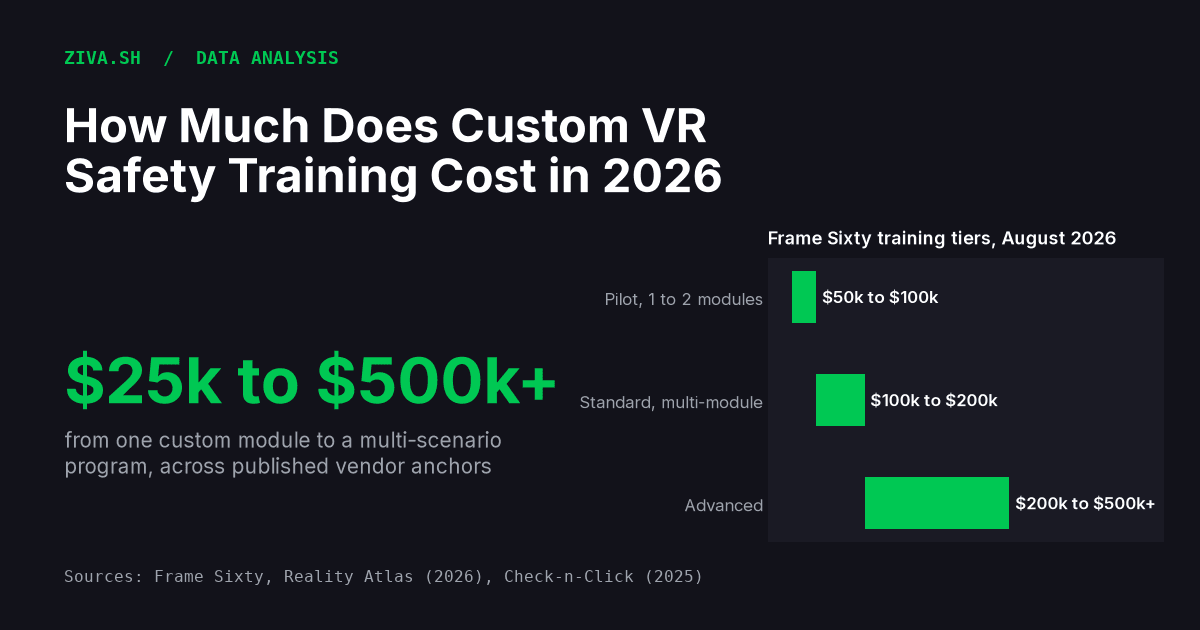
Custom VR training, the category safety training is bought in, costs between $25,000 for a single module and $500,000 or more for a multi-scenario program, according to Reality Atlas’s July 2026 guide to VR training companies . Frame Sixty’s August 2026 cost guide narrows the first purchase to $50,000 to $100,000 for a pilot of one or two modules, $100,000 to $200,000 for a standard multi-module program, and $200,000 to $500,000 and up for advanced builds. For safety specifically, Ludus Global, a VR safety training vendor, says custom module development can start around $40,000 per bespoke scenario . These are published vendor and directory anchors, not audited prices. We collected every one we could verify on its source page, with the date it was published, so you can weigh each one yourself.
TL;DR
| If you are buying | Expect | Source and date |
|---|---|---|
| A pilot of 1 to 2 modules | $50,000 to $100,000 | Frame Sixty, August 2026 |
| A multi-module program | $100,000 to $200,000; $200,000 to $500,000+ with AI scenarios or haptics | Frame Sixty, August 2026 |
| A single custom module at the low end | From $25,000 | Reality Atlas, July 2026 |
| A custom safety scenario | From about $40,000 | Ludus Global, June 2026 |
| Each custom scenario | 6 to 10 weeks; 1 to 2 weeks for a library deployment | Ludus Global, June 2026 |
| A training simulation, kickoff to launch | 8 to 24 weeks | Frame Sixty, August 2026 |
| Each follow-on module | 40 to 60 percent of the first | Frame Sixty citing VR Vision Group, 2026 |
| LMS integration through xAPI or SCORM | $15,000 to $40,000 | Frame Sixty citing VR Vision Group, 2026 |
| Headsets | $400 to $3,500 per headset | Reality Atlas, July 2026 |
| A custom simulation course that is not VR (Level 3) | $20,000 to $40,000+ per finished hour at an assumed $100 per hour | Check-n-Click, December 2025 |
The benchmark table, with dates
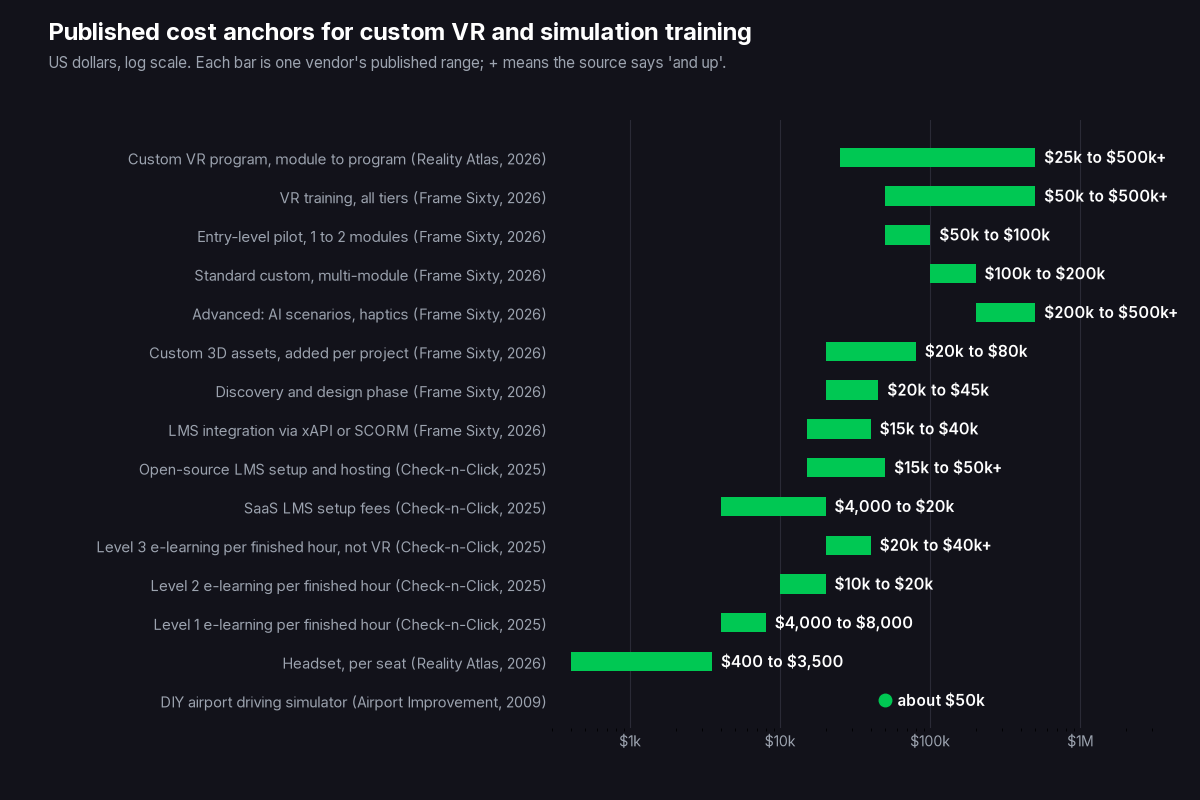
Each row is one published figure, quoted as its source states it. Ranges written with a plus sign are open-ended in the source.
| Item | Range | Basis | Published | Source |
|---|---|---|---|---|
| VR training simulation, all tiers | $50,000 to $500,000+ | Frame Sixty’s own range for training builds | 2026-08-15 | Frame Sixty |
| Entry-level pilot | $50,000 to $100,000 | 1 to 2 modules, some pre-built assets | 2026-08-15 | Frame Sixty |
| Standard custom | $100,000 to $200,000 | Multiple modules, branded 3D assets, LMS integration | 2026-08-15 | Frame Sixty |
| Advanced | $200,000 to $500,000+ | AI scenarios, haptics, multiple environments | 2026-08-15 | Frame Sixty |
| Custom VR program | $25,000 to $500,000+ | Single module up to a multi-scenario program | 2026-07-12 | Reality Atlas |
| Custom safety module | From about $40,000 per bespoke scenario | Custom module development; off-the-shelf libraries avoid it | 2026-06-01 | Ludus Global |
| Off-the-shelf platform licence | $30,000 to $150,000 per year | Depends on user count | 2026-07-12 | Reality Atlas |
| Headset hardware | $400 to $3,500 per headset | Depends on device | 2026-07-12 | Reality Atlas |
| Custom scenario timeline | 6 to 10 weeks per scenario | Off-the-shelf libraries deploy in 1 to 2 weeks | 2026-06-01 | Ludus Global |
| Training simulation timeline | 8 to 24 weeks | Kickoff to launch | 2026-08-15 | Frame Sixty |
| Discovery and design phase | 4 to 6 weeks, $20,000 to $45,000 | Before a 12 to 20 week enterprise build phase | 2026-08-15 | Frame Sixty citing VR Vision Group |
| Share of hours on 3D assets | 50 to 70 percent | Of development hours on an immersive build | 2026-08-15 | Frame Sixty |
| Custom 3D assets | Adds $20,000 to $80,000 | Per project | 2026-08-15 | Frame Sixty |
| Follow-on modules | 40 to 60 percent of the first | The first module pays for the reusable asset and interaction system | 2026-08-15 | Frame Sixty citing VR Vision Group |
| LMS integration, xAPI or SCORM | $15,000 to $40,000 | Per VR Vision Group’s 2026 enterprise pricing | 2026-08-15 | Frame Sixty citing VR Vision Group |
| Agency hourly rate, US and Canada | $100 to $149 per hour | Offshore-weighted global average $25 to $49 | 2026-08-15 | Frame Sixty citing Clutch, August 2026 |
| Level 1 e-learning, per finished hour | $4,000 to $8,000 | 40:1 to 80:1 development ratio at an assumed $100 per hour blended rate; not VR | 2025-12-04 | Check-n-Click |
| Level 2 e-learning, per finished hour | $10,000 to $20,000 | 100:1 to 200:1, same assumption; not VR | 2025-12-04 | Check-n-Click |
| Level 3 e-learning, custom simulations | $20,000 to $40,000+ per finished hour | 200:1 to 400:1+, same assumption; branching and software simulation, not VR | 2025-12-04 | Check-n-Click |
| Level 4 immersive, VR, AR or AI | No figure given | “Comparable to those of software development”; often needs Unity or Unreal developers | 2025-12-04 | Check-n-Click |
| Open-source LMS (Moodle, Open edX) | $15,000 to $50,000+ initially, then $15,000 to $20,000 a year | Implementation, hosting and customization, then maintenance | 2025-12-04 | Check-n-Click |
| SaaS LMS setup fees | $4,000 to $20,000 | On top of the per-seat licence | 2025-12-04 | Check-n-Click |
| In-house eLearning developer | $75,000 to $110,000+ per year | US or Western Europe, salary plus benefits and overhead | 2025-12-04 | Check-n-Click |
| Annual maintenance | 15 to 20 percent of the original development cost | Per year, for updates and browser compatibility; e-learning rule, not VR | 2025-12-04 | Check-n-Click |
| Year-one VR support | 15 to 25 percent of build cost | Updates, bug fixes and content refreshes | 2026-08-15 | Frame Sixty |
| Do-it-yourself airport driving simulator | About $50,000 | One supervisor’s estimate, about 200 hours of his time plus X-Plane; as reported in 2009 | 2009-11-01 | Airport Improvement |
| Commercial driving simulator | “A half-million dollars and more” | The same supervisor’s comparison | 2009-11-01 | Airport Improvement |
What drives the cost
3D assets. Frame Sixty puts 3D asset production at 50 to 70 percent of development hours on an immersive build and says labor is 80 to 90 percent of a typical budget. Custom assets add $20,000 to $80,000 per project on the same page. A site-specific scenario is mostly a modelling job.
Interactivity level. Check-n-Click’s ratios run from 40:1 for a slide-style course to 400:1 and beyond for a custom simulation, which is how one finished hour goes from $4,000 to $40,000 or more at an assumed $100 per hour. The same guide gives its Level 4 immersive tier no dollar figure at all and says the cost is “comparable to those of software development” because it often needs Unity or Unreal developers.
Scenario count and reuse. Follow-on modules cost 40 to 60 percent of the first because the first one pays for the asset library and the interaction system. Frame Sixty’s worked example: a $150,000 first module and three follow-ons land near $420,000, not $600,000.
Delivery and integration. Connecting a simulation to an LMS through xAPI or SCORM adds $15,000 to $40,000 per VR Vision Group’s 2026 pricing. The LMS itself is another line: $4,000 to $20,000 in setup fees for a SaaS product, or $15,000 to $50,000 and up to implement and host an open-source one .
Hardware per seat. Reality Atlas puts headsets at $400 to $3,500 each . Multiply by the number of learners who need to be in a headset at the same time, not by the size of the workforce.
Who does the work. US and Canada VR agencies bill $100 to $149 per hour against an offshore-weighted global average of $25 to $49 , per Clutch’s August 2026 data. An in-house eLearning developer costs $75,000 to $110,000 or more a year with benefits and overhead . Many of the vendors selling this work show a small team: in our September 2026 read of 97 vendor sites, 29 list 2 to 14 people on their team page, 7 list 15 or more, and 54 list nobody.
Refresher cadence. HAZWOPER workers, managers and supervisors must receive eight hours of refresher training annually under 29 CFR 1910.120(e)(8). Each miner must receive no less than 8 hours of annual refresher training, no later than 12 months after the previous one under 30 CFR 46.8. Every refresher is a date by which the scenario must still match the procedure, which is where reuse and editable source pay back.
The do-it-yourself floor
A November 2009 Airport Improvement article describes how Charlotte Douglas International Airport built its own driver-training simulator with help from the US Department of Transportation’s Volpe Center. The airport’s operations supervisor modified a flight simulator using a computer, an LCD screen, off-the-shelf X-Plane software and about 200 hours of his own time, and estimated the whole project at about $50,000 including that time. The Volpe Center contributed $1,000 for the computer equipment. His comparison was that traditional driver-training simulators cost “a half-million dollars and more”. The figure was published 17 years ago and is not inflation-adjusted, but it is the clearest published example of the floor: one person who knows the site, a game engine or simulator that already exists, and time.
How to use the numbers when buying
- Ask for both a per-module price and a per-finished-hour price. The per-module and per-program anchors ($25,000 for one module up to $500,000 and more for a program) and the per-hour anchors ($4,000 to $40,000 and up, for non-VR e-learning) measure different things. A quote that gives you both is easier to compare.
- Ask what share of hours is 3D assets and whether the assets and the project are editable after handoff. At 50 to 70 percent of hours, the assets are the asset. Ziva’s safety training use case hands back an editable engine project for this reason.
- Price follow-on modules at 40 to 60 percent of the first before you sign. If the vendor’s second module costs the same as the first, ask what was reusable.
- Keep LMS integration as its own line ($15,000 to $40,000 for xAPI or SCORM) and the LMS itself as another.
- Run the PwC parity math from its 2020 study before choosing VR over a desktop build: VR content needed up to 48 percent more initial investment than a classroom or e-learning course, reached cost parity with classroom at 375 learners, was 52 percent more cost-effective than classroom at 3,000 learners, and reached parity with e-learning at 1,950 learners. The study covered soft-skills training (inclusive leadership for new managers), not safety training, so treat the thresholds as a rough guide. Below those learner counts PwC’s own course cost more in VR.
- Ask for weeks per scenario, not weeks per project. Ludus Global’s 6 to 10 weeks per custom scenario and Frame Sixty’s 8 to 24 weeks per training simulation are the published ranges.
- Count headsets by concurrent learners at $400 to $3,500 each, and add a maintenance line: Frame Sixty puts year-one VR support at 15 to 25 percent of build cost, and Check-n-Click’s e-learning rule is 15 to 20 percent of the original development cost a year.
What these numbers do not tell you
- Every anchor is a vendor blog post, a vendor cost guide, a directory listicle or one trade article. None is an audited price list, and each vendor has a reason to publish the range it publishes.
- The dollar figures are framed for US buyers. Frame Sixty’s offshore-weighted global rate is the only explicitly non-US price. Ludus Global is a European vendor and Check-n-Click is an Indian one, so their numbers may not match a US quote.
- Three sources are not from 2026: Check-n-Click’s guide is dated December 2025, PwC’s study is from 2020, and the Charlotte Douglas article is from 2009.
- It is a September 2026 snapshot. Vendor pages change without notice.
- None of this is a Ziva price. Enterprise pricing is custom to the organization, engine and use case.
- We did not use the 75 percent versus 5 percent retention figures that Ludus Global says appear all over vendor marketing for VR . They match the NTL learning pyramid (75 percent for practice, 5 percent for a lecture), whose original research is said to have been lost. Work-Learning Research went through the letter NTL sends to people who ask about the percentages and wrote that the research “is NOT accurate, nor could it be” .
Related reading
- State of Interactive Safety Training Vendors, 2026: what 97 vendor sites list and say
- AI Game Engine: Why Ziva Is Built Inside Your Engine: why the 3D and engine work is where the hours go
- Ziva for game studios: From idea to release: how a studio team uses the same tooling
- What is Ziva? Build games faster with AI: the product in one page
If you build or buy this kind of training, Ziva’s safety training use case builds reviewable scenarios from approved procedures, with measurable assessments and an editable handoff. Enterprise pricing is custom to the organization, engine and use case.